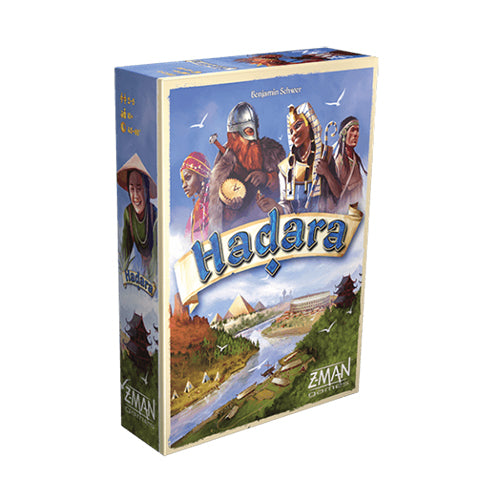
Regras de Hadara
Resumo
Hadara is a civilization-building game played over three epochs. Players buy and sell cards that raise their four tracks (income, military, culture, food), claim colonies, carve statues and buy medals. The player with the most points after final scoring wins.
Preparação
Epoch cards: Sort the epoch cards by the number on their backs and set aside epochs II and III. Split the epoch I cards into five color decks, shuffle each, and place 2 facedown per player of each color on the matching inner spaces of the board. Return the rest of epoch I to the box. In a 4-player game, place 8 cards of each color instead.
Board and colonies: Join the five board segments in any order and place the board in the middle. Sort the 25 colonies by their bottom-left value, shuffle each pile, and place one per player from each pile beside the board with the coin side up. Return the remaining colonies to the box unseen.
Supply: Put the coins and 10-value markers beside the board. Coins are not limited. Set the score pad aside.
Each player: Take a player board, a reference sheet, 8 bonus tiles (2 per color), and 2 gold medals (set them aside). Deal one setup card at random. For the basic game everyone uses side A. Place your four wooden markers on the tracks at the values shown on your setup card, and take the coins it lists.
Um turno
The game has two phases per epoch.
Phase A (drawing): Find the first player from initiative on setup cards. In epoch I it is the lowest value, in epoch II the second-lowest, and in epoch III the third-lowest. In a 2-player game the lowest-initiative player goes first in epochs I and III, and the other player receives 1 coin at the start of epoch I. In a 4- or 5-player game, players who will never be first get 1 coin at the start of epoch I. The first player points the wheel so each player icon faces a deck.
All players simultaneously draw 2 facedown cards from their icon's deck. Choose one and discard it faceup on the discard pile of its color. Then buy or sell the other. Discarding and buying or selling both at once is not allowed. Rotate the wheel clockwise and repeat until every player has drawn from every deck.
After phase A, resolve in order:
1. Income: Gain coins equal to your income track.
2. Take a colony: Starting with the first player, clockwise, each player may take one colony whose requirement (military track value) they meet. Take it and either plunder it for the green coin amount, without flipping it, or integrate it by paying the red amount and flipping it to gain the reverse-side track values. You cannot look at the back before deciding.
3. Carve a statue: Starting with the first player, clockwise, each player may carve one statue whose culture requirement they meet. Place one unused bonus tile on its space, either faceup to gain the track bonus or facedown to score the listed points at the end.
4. Feed your people: Each card you own needs 1 food. If you have more cards than your food track value, choose cards to remove and place them out of play, reducing tracks by their values.
Buying and selling: To buy, pay the cost minus 1 for each card of that color you already own (minimum 0), place the card under your board by color, and move your tracks up by its values. Tracks past 10 wrap around using a 10-value marker. To sell, place the card facedown beside the board (out of the game) and gain coins: 2 in epoch I, 3 in epoch II, 4 in epoch III.
Phase B (discard piles): Starting with the first player, clockwise, each player takes the top faceup card from any discard pile and buys or sells it. Discarding is not allowed. Continue until no cards remain on the board. Then resolve income, taking a colony, carving a statue, and feeding your people as in phase A, followed by buying medals.
Buying medals: Silver medals cost the amount on the reference sheet and are placed as bonus tiles on silver spaces. Gold medals are placed on gold spaces. You may buy up to 2 of each kind over the game and any number in each medal step, as allowed by the amounts shown.
Fim do jogo
After epoch III is finished, the game ends and final scoring takes place. Epochs I and II end with the start of the next epoch.
Pontuação
Score each player's points on the score pad:
- Colonies: the bottom-right values of your colonies.
- Statues: their listed points, plus any points on facedown bonus tiles.
- Silver medals: half the value of the matching track, rounded up.
- Gold medals: 7 points per set of 5 differently colored cards, per gold medal.
- Cards: the point values on each of your cards.
- Coins: you may pay coins to score 1 point per 5 coins paid.
The player with the most points wins. In a tie, the tied player with the most leftover coins wins. If still tied, the tied players share the win.
Variantes
Basic game: Remove the starred purple cards from epoch I, II and III, and use side A of the setup cards.
Advanced game: Use the starred purple cards and let each player choose which side of their setup card to use. Purple cards with effects work differently from the basic game: each effect applies while you own the card, and it is lost if the card is removed. The rulebook lists effects for each epoch and game version on its purple card summary page.
The rulebook gives no solo or team variant.
Alterações
- Variantes, por o rascunho do manual de regras, 22 de novembro de 2026 (mostrada agora)
- Pontuação, por o rascunho do manual de regras, 22 de novembro de 2026 (mostrada agora)
- Fim do jogo, por o rascunho do manual de regras, 22 de novembro de 2026 (mostrada agora)
- Um turno, por o rascunho do manual de regras, 22 de novembro de 2026 (mostrada agora)
- Preparação, por o rascunho do manual de regras, 22 de novembro de 2026 (mostrada agora)
- Resumo, por o rascunho do manual de regras, 22 de novembro de 2026 (mostrada agora)