Regras de Here I Stand
Resumo
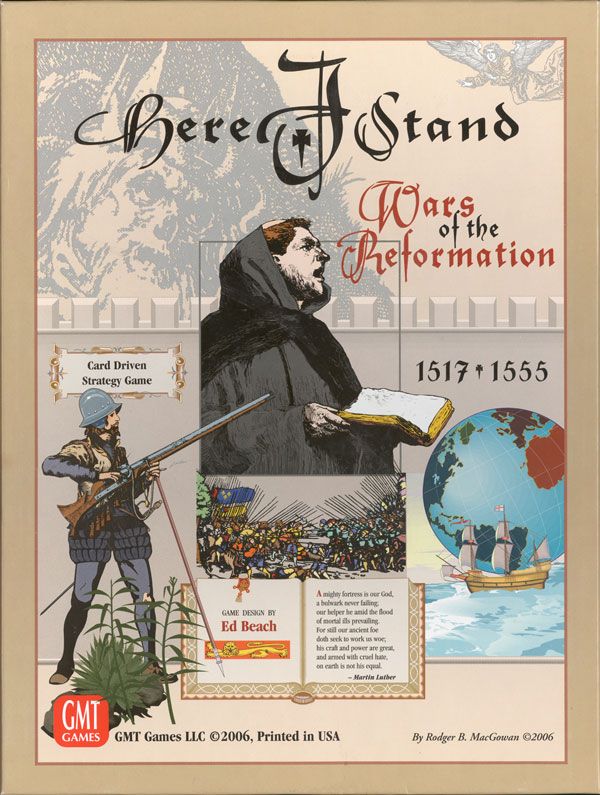
Here I Stand is a game for two to six players about the military, political and religious conflicts in Europe at the start of the Protestant Reformation, 1517 to 1555. Each player controls one or more of the major powers (Ottoman, Hapsburgs, England, France, Papacy, Protestants) and works to gain political control of spaces on the map. This part of the rulebook does not state the victory conditions; the winner is decided in the Victory Determination Phase, which is covered in the part not included here.
Several powers compete for victory points (VP), and this part of the rulebook sets out how the game is won. A power can win instantly by a Military or Religious Victory, or the game is decided at the end of a turn by VP totals. The Protestant player wins a Religious Victory by converting over 50 spaces to Protestant religious influence.
Preparação
Map: every space starts under the political control of its home power. Gray spaces are independent. Every space starts under Catholic religious influence except Ottoman home spaces, which are immune to religious change.
Control markers: every key must carry a square control marker on the map or on its power card. Hexagonal markers are kept off the map until needed.
Cards: cards without a turn number start in the deck. Turn 1 begins with the Protestant player playing the Luther's 95 Theses Mandatory Event, which is not dealt.
Leaders, reformers and debaters: Luther is placed in Wittenberg on Turn 1, and Zwingli, Calvin and Cranmer enter on set turns. Maurice of Saxony enters on Turn 6. The Protestant player starts with four German-speaking debaters and the Papacy starts with five.
Algiers is out of play, and no unit may enter it, until the Barbary Pirates Mandatory Event is played.
Um turno
Each turn has nine phases, in this order:
- Luther's 95 Theses (Turn 1 only).
- Card Draw: add leaders, reformers and debaters; add new cards to the deck (Turn 3 and later) and shuffle; roll for New World riches; deal cards.
- Diplomacy: negotiations, peace (not on the final turn), ransom of captured leaders, removing excommunication, and declarations of war.
- Diet of Worms (Turn 1 only).
- Spring Deployment: each power may move one formation from its capital to a friendly space at no CP cost.
- Action Phase: powers take impulses in Impulse Order (Ottoman, Hapsburgs, England, France, Papacy, Protestant) until all powers pass in consecutive impulses.
- Winter: units return to fortified spaces, reinforcements arrive, and Mandatory Events come due.
- New World: voyages of exploration and conquest are resolved.
- Victory Determination: check for a winner; if none, advance the turn marker and start a new turn.
In each Action Phase impulse, a player does one of three things: play a card for Command Points (CP), play a card as an event, or pass. Cards played for CP go to the discard pile, and the CP shown in the card's upper-left shield are spent on actions costing 1 to 4 CP. CP must be spent in the impulse in which they were earned. A power may not pass while holding its Home card or an unplayed Mandatory Event, and may not pass with more cards than its ruler's administrative rating. A power with no cards must pass.
The Victory Determination Phase ends each turn. After checking for Standard and Domination wins, if there is still no winner and it is not Turn 9, the turn marker advances and a new turn begins. Players should record each power's VP total at the end of each turn on the Victory Record Sheet.
Fim do jogo
The game lasts nine turns or fewer. A Military or Religious victory may end it during the Action Phase. The Victory Determination Phase at the end of each turn checks for a winner. The victory conditions themselves are not in this part of the rulebook.
Military Victory: a power other than the Protestant wins immediately in the Action Phase if its Auto Win space is open on its power card and none of its marked spaces contain an Unrest marker. A revealed Auto Win space during the Diplomacy Phase does not count unless it is still revealed when the Action Phase starts. Religious Victory: the Protestant wins immediately if it reaches religious influence over 50 spaces with no Unrest markers on them. Standard Victory: in the Victory Determination Phase, the game ends if any power has 25 or more VP. Domination Victory: from Turn 4 onward, a power with fewer than 25 VP wins if it leads every other power by at least 5 VP. Time Limit Victory: if no one has won by the end of Turn 9, the power with the most VP wins.
Pontuação
A power's VP total is its base, special, and bonus VP. Base VP: English, French, Hapsburg, Ottoman and Papal base VP come from the last open box on the power card based on keys controlled; boxes covered by Unrest markers are not counted, and a fully covered card gives 0. The Protestant earns 2 VP for each electorate under both Protestant religious influence and political control. Special VP: the Ottoman earn VP from the piracy track. The Hapsburgs earn 1 VP per electorate under their political control that is not in unrest, but only after the Schmalkaldic League event has been played. England earns VP for a male heir (5 VP if Edward VI is born during a Six Wives of Henry VIII roll, or 2 VP if Edward has not been born but Elizabeth I has) and 1 VP per 2 English home spaces under Protestant influence, rounded down. France earns 1 VP per chateau built with the Patron of the Arts Home card. The Papacy earns VP from the Protestant Spaces track and 1 VP per space on the lower St. Peter's track. The Protestant earns VP from the Protestant Spaces track. Bonus VP: awarded for debaters burned or disgraced, successful voyages of exploration or conquest, the Copernicus and Michael Servetus events, Julia Gonzaga followed by successful Ottoman piracy in the Tyrrhenian Sea, the War Winner marker, the Master of Italy VP marker, and completed Bible translations (1 VP per language). Copernicus and Michael Servetus may be played during the Victory Determination Phase only if they lift a power from a Domination loss. Ties: for a Standard or Time Limit win, the tied power with the higher VP total in the previous turn wins. If still tied, go back one turn at a time until the tie is broken.
Alterações
- Pontuação, por o rascunho do manual de regras, 23 de novembro de 2026 (mostrada agora)
- Fim do jogo, por o rascunho do manual de regras, 23 de novembro de 2026 (mostrada agora)
- Um turno, por o rascunho do manual de regras, 23 de novembro de 2026 (mostrada agora)
- Preparação, por o rascunho do manual de regras, 23 de novembro de 2026 (mostrada agora)
- Resumo, por o rascunho do manual de regras, 23 de novembro de 2026 (mostrada agora)