Regras de Ishtar: Gardens of Babylon
Resumo
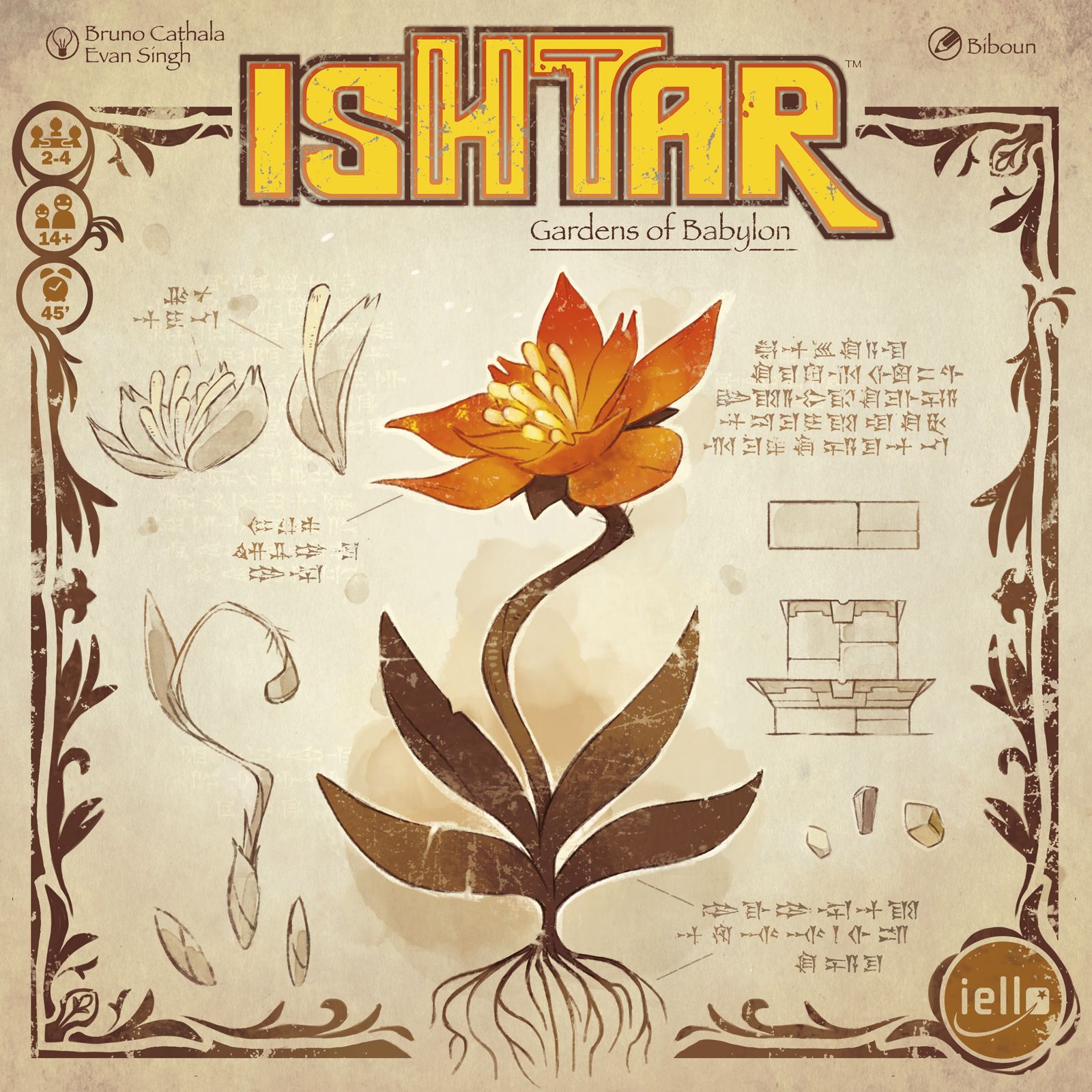
Ishtar is a tile-laying game in which players grow gardens of vegetation on desert terrain, linked to magical fountains. Points come from planted Trees, controlled flowerbeds, controlled fountains and upper-level Skills. The player with the most victory points at the end wins.
Preparação
Place one Terrain Board per player plus 2 extra, connected together in the middle of the table. Put a random Fountain on each marked spot and a Gem of the matching color on each Rock Space. Set the Carpet Board beside the play area with the Gems within reach.
Randomly place the 6 Cup Tiles on the Carpet Board. On each Cup, make a face-down pile of 6 Basic Vegetation Tiles of the matching shape and cover it with the matching Starting Tile face up. With 2 players, remove the 2 bottom tiles of each pile. With 3 players, remove the bottom tile of each pile. Place the Blooming Tokens on the Carpet Board.
Shuffle the Tree Cards into a face-down draw pile, reveal the first 5 next to it and place a Tree on each. Deal a random Player Board to each player, making sure one is the First player's board. Each player takes the 4 Assistants of their color, keeps 2 in front of them and places 2 in the middle of the Carpet Board. Each player gets 1 purple Gem. The first player also takes the Watering Can. Keep the Scoring Pad handy.
Um turno
Players take turns clockwise. On your turn, perform these steps in order:
- Choose a tile: Move the Watering Can clockwise to the next pile with tiles, skipping empty piles. On the first turn, the first player puts it on any pile. You may move it further, paying 1 Gem for each extra pile passed. Take the top tile of the pile where the Watering Can now sits, then reveal the top tile of the pile it came from.
- Place the tile: Add it to any Terrain Board. It may only cover Sand and/or Rock Spaces, never a Fountain, Sacred Tablet or other tile. At least one of its spaces must touch a Fountain or a previously placed tile. It cannot join Gardens connected to two different Fountains, and it cannot leave two Assistants on the same Flowerbed.
- Collect Gems: Take the Gems from any Rock Spaces the tile covered.
4. Special action: Only if the tile shows an icon, and you may skip it but cannot save it:
- Assistant icon: place one of your Assistants from in front of you on the icon, unless another Assistant is already on that Flowerbed.
- Skill icon: pay 2 Gems from your supply onto a free Skill on your board. Upper-level Skills need the Skill below them completed first. Gems on your board are permanent. You may unlock only one Skill per turn, and each Skill only once.
- Wild icon: use it as either of the above.
- Plant Trees: Choose one of the available Tree Cards, or your reserved one, and pay its Gem cost. Place it face down in front of you and put its Tree marker on a free Grass Space. You may repeat this if you can afford another. Then reveal the next card from the draw pile and place a Tree on it. Your turn ends.
Fim do jogo
The game ends as soon as two piles of Vegetation Tiles are empty. Finish the current round so that every player has taken the same number of turns, then proceed to final scoring.
Pontuação
Discard any reserved Tree Card you never planted. Then score:
- The points printed on each of your planted Trees.
- 1 point for each visible Flower in Flowerbeds controlled by your Assistants.
- For each Fountain you control: 4 points for purple, 6 for red, 8 for white.
- Points from your upper-level unlocked Skills, as explained on the Skills guide.
A Flowerbed is a group of connected Flower Spaces. A player controls the Fountain if they have the most Flower Spaces in Flowerbeds of the Gardens connected to it. If players are tied, all tied players control it. Record scores on the Scoring Pad. The player with the most victory points wins. The rulebook gives no tiebreaker for equal totals.
Variantes
The rulebook gives no separate solo, team or short-game rules. It does give player-count setup differences (2 or 3 players, see setup) and allows a different terrain layout for each game.
Alterações
- Variantes, por o rascunho do manual de regras, 22 de novembro de 2026 (mostrada agora)
- Pontuação, por o rascunho do manual de regras, 22 de novembro de 2026 (mostrada agora)
- Fim do jogo, por o rascunho do manual de regras, 22 de novembro de 2026 (mostrada agora)
- Um turno, por o rascunho do manual de regras, 22 de novembro de 2026 (mostrada agora)
- Preparação, por o rascunho do manual de regras, 22 de novembro de 2026 (mostrada agora)
- Resumo, por o rascunho do manual de regras, 22 de novembro de 2026 (mostrada agora)