A carregar a página…
Diese Seite auf Deutsch ansehen
Vedi questa pagina in italiano
Ir para o conteúdo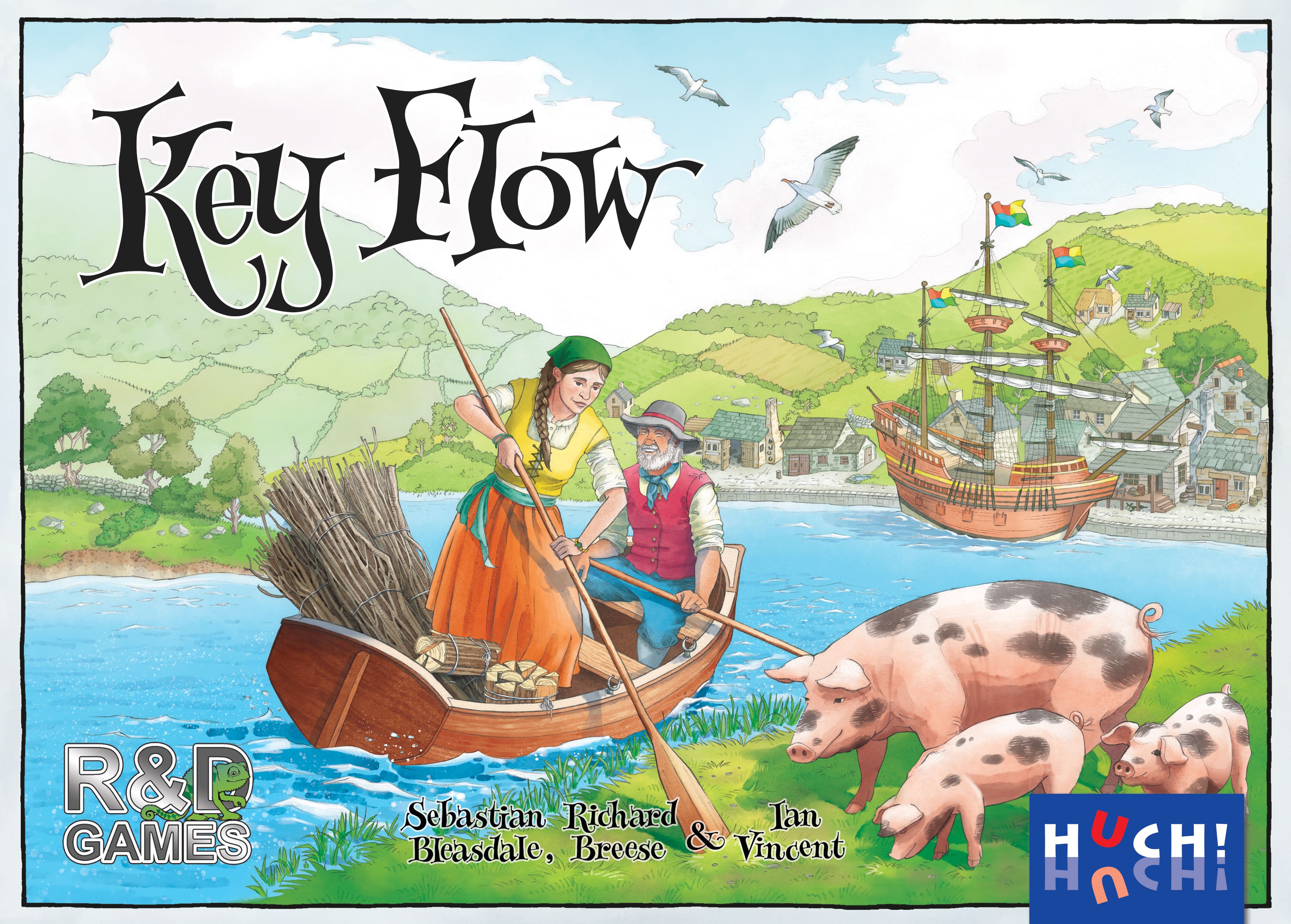
Key Flow is a game over four seasons (spring, summer, autumn, winter) in which players build villages from village cards and use keyple cards to generate resources, skill tiles, tokens and actions. Points are scored at the end of winter from buildings, upgrades, resources, animals and winter cards, and the player with the most points wins.
Sort the cards by the back icons into home, store and the four seasons. For spring, summer and autumn, return a set number of unseen cards to the box based on player count (2 or 3 players: 6; 4 players: 4; 5 players: 2; 6 players: 0). Return numbered cards marked with a higher player count than the number of players. Shuffle each season's remaining cards into a deck, and form separate winter and winter numbered decks, giving five decks in total. Place resource counters, keyple tokens, upgrade tiles and skill tiles (single-sided face down and mixed, double-sided separately) within easy reach.
Each player takes a home card placed face up in front of them, which is kept in their village, and a store card placed to the side. Each player is dealt six spring cards (eight in a two-player game) as their starting hand and five winter cards (seven in a two-player game), keeping the winter cards face down next to their store card and returning any unused winter cards unseen to the box. Remaining season decks are set aside for later.
Each season, players are dealt cards from that season's deck (spring is already dealt at setup). Each player looks at their hand, secretly keeps one card, and passes the rest to a neighbour: to the left in spring and autumn, to the right in summer and winter. All players then reveal their chosen card simultaneously and play it, and the process repeats until all cards in the hand have been played. Players may instead discard their chosen card and take a keyple token.
Village cards are placed upright in the village: road cards go in the top row and river cards go in the bottom row, offset by half a card width. A new card must connect to at least one existing card, though gaps may be left. Keyple cards are placed above top-row village cards, in the player's own village or an immediate neighbour's village, as the direction arrows allow. A keyple card can only work on a building that has at most as many previously played keyple cards as its keyple count allows (one keyple card works on empty buildings, two on buildings with one card, three on buildings with up to two cards). Keyple tokens can raise a card's keyple count up to three.
Simultaneous play means that actions depend on the game state before the turn: a card placed this turn cannot be used this turn, and upgrades built this turn cannot be used this turn. Resources are placed on the village card that generated them (or on the home card if generated in a neighbour's village). Skill tiles and keyple tokens are kept in front of the player. Transport and upgrade actions let players move resources along roads or rivers and upgrade buildings.
After all of a season's cards have been played, players may spend keyple tokens for extra actions in their own village. One token activates an unused or once-used village card, two tokens activate a card already used twice, and a card used three times cannot be used again. Then all used keyple tokens are returned to supply, and the season's keyple cards are placed under the player's store card for final scoring. Players may look at cards under their store cards only between seasons.
The game ends after winter. At the end of autumn, each player chooses one of their winter cards they were dealt at the start, and all players reveal and place their chosen card simultaneously into their village. The unchosen winter cards are shuffled with the numbered winter cards to form the winter deck. Final scoring takes place at the end of winter.
Players add up points from the following sources:
The player with the most points wins. A tie is broken by the most sheep, then the most pigs, then the most cows, and any remaining tie is shared.
The rulebook describes a competition rules option, which is not recommended for regular play. In it, all players declare a card, keyple cards are revealed and played in numerical order, then village cards are played, and players pick up the cards placed next to them, repeating until all cards are played. Keyple tokens are then played as additional actions.
The rulebook also notes that rules for two-player games differ: arrows point to the opponent's home card and the cards beyond it on either side. The rulebook does not describe solo or team variants.