Regras de Nexus Ops
Resumo
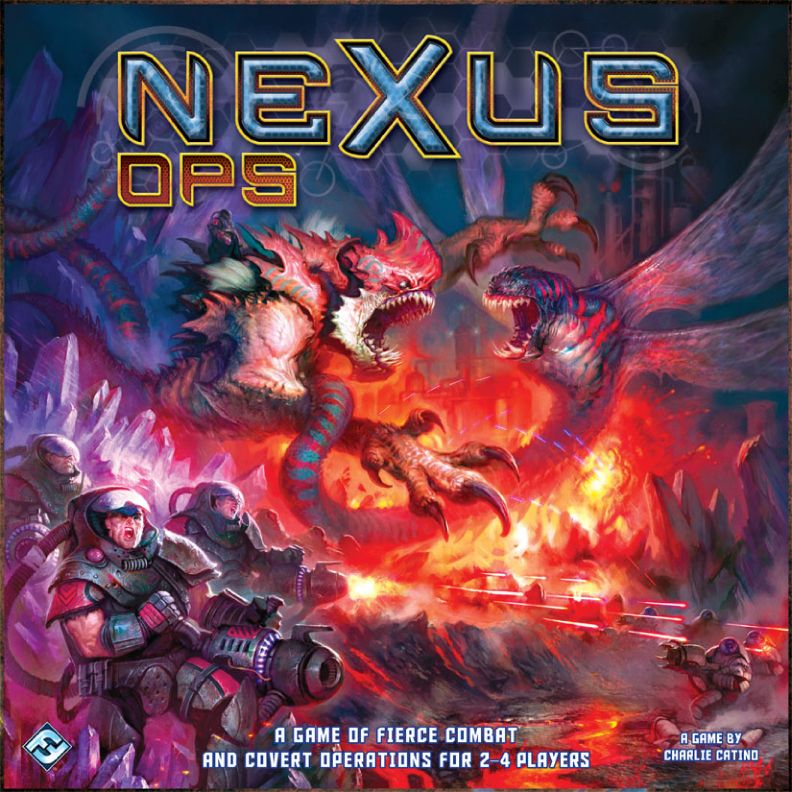
Nexus Ops is a battle game for two to four players, in which factions of corporate troops and alien life forms fight over rubium on an alien moon. Players deploy units, explore, mine, win battles, and complete secret missions. The first player to earn 12 or more victory points wins.
Preparação
- Choose first player: Choose randomly and give that player the first player marker.
- Choose factions: Starting with the first player, each player takes a faction's figures and reference sheet, with the red and black striped side up.
- Place terrain: Put the Monolith hex in the middle. Shuffle the single-hex tiles facedown and place them in a ring around the Monolith. Shuffle the double-hex tiles facedown and place them in a ring outside those. See the setup diagram.
- Build bases: Place one home base tile per player beside the board, as shown in the diagram for the player count. Then flip all terrain tiles faceup.
- Prepare decks: Make a Secret Mission deck and an Energize deck, both facedown. Place the Battle Victory cards faceup as a deck.
- Exploration tokens: Return the green-bordered tokens to the box unless using the extra exploration tokens rule. Shuffle the rest and place one facedown on each hex except home bases and the Monolith.
- Supplies: Make a rubium supply and place the dice nearby.
- Starting rubium: The first player gets 8 rubium. Each later player, going clockwise, gets 3 more than the player before.
Um turno
Players take turns in clockwise order. On your turn, perform these phases in order:
- Deployment: Spend rubium to buy units and place them on any of your home base hexes, even if an opponent's units are there. Spent rubium goes back to the supply. You may also play Deployment Energize cards. Units are limited by the figures left in your supply. Destroyed units return to supply.
- Movement: Move each unit once. Most move one hex. A unit entering an enemy hex must stop there. You cannot move from a contested hex into another enemy-controlled or contested hex, but you can move from a battle into your own controlled or empty hexes.
- Exploration: Reveal facedown exploration tokens in hexes where your units are. A unit token gives you that unit from supply, and the token is then removed. A refinery token stays faceup to mark a refinery. A token with both gives both rewards.
- Battle: Fight one battle in each contested hex where you have units. You choose the order.
- Mining: In each controlled hex with a refinery and at least one of your miner units (Humans, Fungoids, or Crystallines), take rubium equal to the refinery's number.
- Draw: Draw one Secret Mission card. If you control the Monolith, also draw two Energize cards.
Battle: Units attack in battle order, strongest first. Each unit rolls once. The attacker rolls black dice and the defender rolls white dice. Each die that equals or beats the unit's combat value is a hit, and the opposing player removes one of their units per hit. A battle ends after each unit type has attacked, or when one side has no units left in the hex. If the attacker destroys all the defender's units, or both sides are wiped out, the attacker wins. The attacker then draws a Battle Victory card. The defender, if they lose, draws an Energize card.
Fim do jogo
The game ends immediately when either of these happens:
- A player reaches 12 or more victory points and wins.
- A player is eliminated. This happens when they have no units on the board and cannot afford any units, even after trading cards for rubium.
Pontuação
Victory points come from Battle Victory cards (1 point each) and Secret Mission cards (1 to 3 points each, shown in the upper-left corner). All faceup cards in your play area count.
If the game ends because of an elimination, the player with the most victory points among the remaining players wins. Ties are broken in this order:
- Most controlled hexes.
- Most units on the board.
- Most rubium tokens.
If still tied, the game is a draw.
Variantes
The rulebook lists these optional rules. The group should agree on them before play, and some can be combined.
- Time is of the essence: The game ends at 10 victory points.
- In for the long haul: The game ends at 14 victory points.
- Executive orders: Each player gets one Secret Mission card during setup.
- King of the Hill: If you control the Monolith in your Draw phase, you may take a King of the Hill card (worth 1 point) instead of two Energize cards. Others then each draw an Energize card.
- Exchanging cards for rubium: During your turn you may discard Energize and Secret Mission cards for 1 rubium each.
- Four-player teams: Teammates sit across from each other. The first team to reach 20 combined victory points wins. Teammates may pass one card at the end of the active player's Draw phase.
- Vortex: Flip the Monolith hex to its Vortex side. Before the first player's turn, dice decide which units are moved and destroyed, and the Vortex gives Energize cards to adjacent controllers.
- Top priority: Draw two Secret Mission cards and keep one.
- Extra exploration tokens: Use the six bonus green-bordered tokens in place of the normal ones.
- Intercepted transmissions: Place extra Secret Mission cards faceup as a shared line that the active player may fulfill.
- Alternate units: Use the alternate side of the reference sheets, with the clarifications given in the rulebook.
- Alternate two-player boards: Energy Dependence or Bad Neighbors setups.
Alterações
- Variantes, por o rascunho do manual de regras, 23 de novembro de 2026 (mostrada agora)
- Pontuação, por o rascunho do manual de regras, 23 de novembro de 2026 (mostrada agora)
- Fim do jogo, por o rascunho do manual de regras, 23 de novembro de 2026 (mostrada agora)
- Um turno, por o rascunho do manual de regras, 23 de novembro de 2026 (mostrada agora)
- Preparação, por o rascunho do manual de regras, 23 de novembro de 2026 (mostrada agora)
- Resumo, por o rascunho do manual de regras, 23 de novembro de 2026 (mostrada agora)