Regras de Qin
Resumo
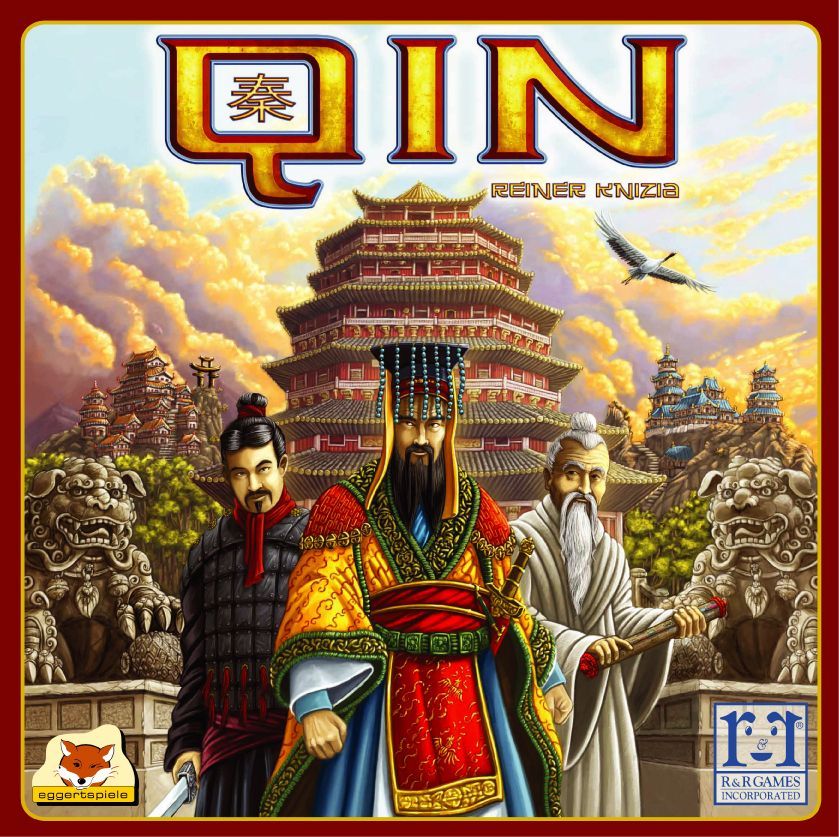
In this tile-placement game set in ancient China, players build provinces and seize villages to gain control of the board. Each player has a fixed supply of pagodas, and the first player to place their last pagoda wins.
Preparação
Place the double-sided board in the middle of the table. For a first game, use the "Bird" side.
Shuffle the tiles and deal each player 3 face-down tiles as a hand. Put the rest in several face-down piles beside the board.
Each player takes pagodas of one color: 24 in a 2-player game, 19 in a 3-player game, or 15 in a 4-player game. Return spare pagodas to the box.
The youngest player starts, and play moves clockwise.
Um turno
On your turn, play exactly one tile from your hand onto the board, then carry out the events it triggers.
- Place the tile only on grassland spaces, never on province spaces, villages, or waters.
- At least one province space of the tile must share an edge with an existing province space of any color. Touching at corners alone is not enough, and villages do not count.
- You may rotate the tile horizontally or vertically.
After placing, resolve the events the tile triggers:
- Found province: a new group of 2 or more same-colored province spaces gets one of your pagodas.
- Expand province: joining a tile to an existing same-colored province adds to it. When a province reaches 5 or more spaces it becomes a major province, marked by a double pagoda (a second pagoda on top). A major province can grow larger but holds only one double pagoda.
- Connect village: if your province or major province now edges an unoccupied village, you place a pagoda there. A village holds only one pagoda.
- Conquer village: if a village borders several provinces, a player with more pagodas adjoining it than the village owner takes it. The old owner gets their pagoda back. Double pagodas count as 2, and the pagoda on the village itself does not count. Ties do not change ownership.
- Absorb province: joining separate same-colored provinces forms one major province. The player with the most spaces from the original provinces takes control, and the tile's own spaces do not count. Displaced pagodas return to their owners. Joins are not allowed if two or more players would tie for control. Major provinces can never be absorbed and cannot be combined with each other, although a major province can absorb smaller ones.
At the end of your turn, draw one tile from any pile and add it to your hand. If the piles are empty, you simply keep playing with the tiles you hold.
Pontuação
If the game ends without a player running out of pagodas, the player with the most pagodas on the board wins. If players are tied, they share the victory.
In a series of games, note each player's remaining pagodas after every game. After the last game, the player with the lowest total of remaining pagodas across the series wins.
Variantes
The rulebook suggests playing a series of games, for example one game on each side of the board. The winner is decided by the lowest total of remaining pagodas, as described under scoring.
Alterações
- Variantes, por o rascunho do manual de regras, 23 de novembro de 2026 (mostrada agora)
- Pontuação, por o rascunho do manual de regras, 23 de novembro de 2026 (mostrada agora)
- Um turno, por o rascunho do manual de regras, 23 de novembro de 2026 (mostrada agora)
- Preparação, por o rascunho do manual de regras, 23 de novembro de 2026 (mostrada agora)
- Resumo, por o rascunho do manual de regras, 23 de novembro de 2026 (mostrada agora)