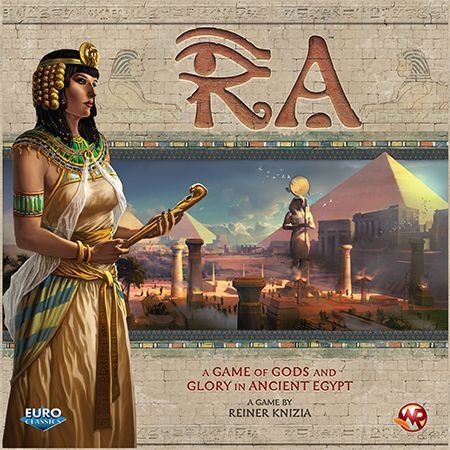
Regras de Ra
Resumo
Ra is a game set in Ancient Egypt in which players act as royal advisors, collecting tiles and bidding with sun disks over three rounds called epochs. Points come from the tiles you hold at the end of each epoch, and the player with the highest score after the third epoch wins.
Preparação
- Place the game board in the center of the play area.
- Place the Ra statue next to the board.
- Put all 180 tiles in the cloth bag and mix them well.
- Each player takes two 5-point tablets and places them facedown in front of him. Place the remaining tablets faceup near the board as the supply.
- Put sun disk 1 on the sun space in the center of the board. Sort the other sun disks into groups using the table for your player count. Two players use disks 1-9, three or four players use disks 1-13, and five players use all 16.
- Deal one group to each player at random. Each player places his sun disks faceup in front of him.
Um turno
The player with the highest-numbered sun disk takes the first turn of each epoch, and play goes clockwise. A player with no faceup sun disks skips his turn.
On his turn, a player must do exactly one of these actions:
- Draw a Tile: Draw one tile from the bag. A Ra tile goes on the Ra track, and any other tile goes on the auction track. If the auction track is full, this action cannot be taken. The first Ra tile of an epoch goes on the start space for the player count, and later Ra tiles fill the next space to the right. After placing a Ra tile, the player takes the Ra statue and an auction happens. If the Ra tile lands in the final space, no auction happens and the epoch ends.
- Invoke Ra: The player says he invokes Ra, takes the Ra statue, and an auction happens.
- Spend God Tile(s): Return a god tile to the box to take one non-god tile from the auction track for each god tile spent. Place taken tiles faceup in front of you. Resolve any disaster tile right away. Tiles left empty on the auction track can be refilled by later draws.
Auctions:
An auction starts when a Ra tile is drawn or when Ra is invoked. The player who caused it is the Ra player. Bidding starts with the player to the left of the Ra player and goes clockwise, ending with the Ra player. Each player bids once or passes. The first bid can be any sun disk, and each later bid must be a higher-valued disk.
- If a Ra tile was drawn and everyone passes, the tiles stay on the auction track.
- If Ra was invoked, the Ra player must bid when the other players pass and the auction track is not full. If the track is full and everyone passes, discard all auction track tiles to the box.
The highest bidder takes all tiles on the auction track faceup, and takes the sun disk on the sun space and places it facedown in front of him. Those facedown disks cannot be used for the rest of the epoch. He then puts his winning bid disk faceup on the sun space for the next auction. Other bid disks return to their owners. The winner resolves any disasters he took. Play then continues with the player to the left of the Ra player, whatever the auction result.
Disasters:
Disasters are black-bordered, cracked tiles. For each one taken, the player discards the disaster plus two matching tiles:
- War: two civilization tiles
- Funeral: two pharaoh tiles
- Drought: two river tiles, with flood tiles discarded before Nile tiles
- Earthquake: two monument tiles
If he has fewer than two matching tiles, he discards as many as he can. The player chooses which matching tiles to discard, except for drought.
All tiles must stay faceup and organized so opponents can see them, and tiles cannot be stacked or covered.
Fim do jogo
An epoch ends immediately in either of these cases:
- All players' sun disks are facedown.
- A Ra tile is placed in the final space of the Ra track. This does not start an auction.
When an epoch ends, discard all tiles on the Ra track and the auction track to the box. The sun disk on the sun space stays where it is. Each player then scores, adjusts his tablets, flips all his sun disks faceup, and discards every tile without a scarab icon. Tiles with a scarab icon stay for the whole game. The player with the highest-numbered sun disk takes the first turn of the next epoch.
The game ends after scoring at the end of the third epoch.
Pontuação
At the end of each epoch, every player scores from his tiles:
- Pharaohs: The player with the most pharaoh tiles gains 5 points. The player with the fewest loses 2 points. Ties at the top or bottom mean every tied player gains or loses those points. If everyone has the same number, nothing changes.
- Gold: 3 points for each gold tile.
- Gods: 2 points for each unspent god tile.
- River: If a player has at least one flood tile, each river tile is worth 1 point. Without any flood tile, Nile tiles are worth nothing.
- Civilization: Having zero civilization tiles loses 5 points. Having three, four, or five different types gains 5, 10, or 15 points. Extra copies of a type add nothing.
Track scores with tablets, making change from the supply as needed. Tablets stay facedown. A score can never drop below zero.
At the end of the third epoch only, also score:
- Sun disks: Add the values of all of a player's sun disks, faceup and facedown. The highest total gains 5 points and the lowest loses 5 points. Ties share the gain or loss. If everyone is equal, nothing changes.
- Monuments: There are eight types. Each type you hold gives 1 point, with 6 or fewer types. Seven types gives 10 points, and all eight gives 15 points. Each group of three identical monuments is worth 5 points, four is worth 10 points, and five is worth 15 points.
The player with the highest score after the third epoch wins. If players are tied, the tied player with the highest-numbered sun disk wins.
Alterações
- Pontuação, por o rascunho do manual de regras, 23 de novembro de 2026 (mostrada agora)
- Fim do jogo, por o rascunho do manual de regras, 23 de novembro de 2026 (mostrada agora)
- Um turno, por o rascunho do manual de regras, 23 de novembro de 2026 (mostrada agora)
- Preparação, por o rascunho do manual de regras, 23 de novembro de 2026 (mostrada agora)
- Resumo, por o rascunho do manual de regras, 23 de novembro de 2026 (mostrada agora)