Regras de Ragusa
Resumo
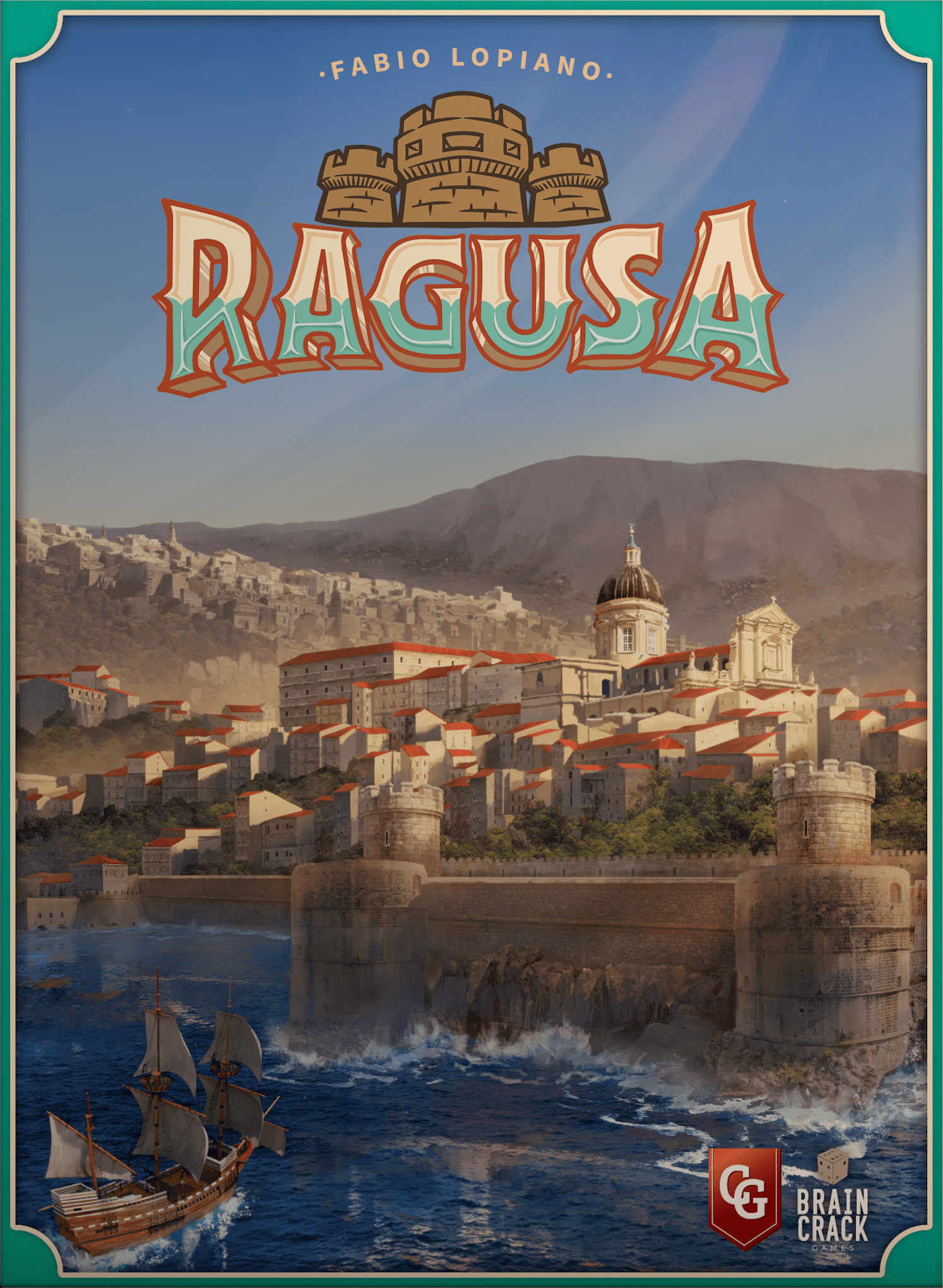
Ragusa is a game set in a 15th-century Mediterranean port where players place houses and towers to build the city. Houses give access to resources, which let players produce commodities, sell them, trade them for ship goods, and build city walls and towers. The player with the most victory points at the end of the game wins.
Preparação
- Give each player a player mat and 3 tracker beads, placing one bead on each commodity symbol on the mat's left side.
- Give each player their towers and houses. With 2 players, use the 2-player rules. With 3 players each gets 12 houses, with 4 players 10 each, and with 5 players 9 each.
- Place each player's disc on square zero of the scoring track.
- Keep the 6 resource tracker cards of each colour nearby.
- Place one tracker bead on the starting space of each of the three commodity value tracks on the board.
- Shuffle the ship cards and place five on the marked harbour spaces, ship side down. Place the rest as a face-down deck nearby.
- For each of those five cards, move the matching commodity marker up by the number of arrows on the card, then flip the card to its ship side.
- Shuffle the bonus deck and deal each player three face down. Each player keeps one and discards the other two face down.
- Shuffle the discarded bonus cards back into the bonus deck. Place the ship and bonus decks face down near the board.
- Choose a starting player at random.
Um turno
Players take turns clockwise. On your turn, place one of your houses on an available spot. A spot is available if it has no house on it, since towers do not block spots.
Each spot borders three regions, and you must meet the building requirement for each one (not for the spot itself):
- Country regions require Wood. City regions require Stone.
- The number of your houses around a single region may not exceed the amount of that resource you have access to. Your first house next to a country region needs 1 Wood, and your third needs 3 Wood.
- Resources are not spent, so the same Wood or Stone can satisfy several regions.
- Sea regions need nothing extra.
- Some city regions have special requirements, such as Grapes or Fish.
After placing, activate the regions one at a time:
- Country regions give the resource shown. Update your tracker card for that resource, flipping it when you move from 4 to 5.
- City regions without a clockwise arrow activate only the house you just placed.
- City regions with a clockwise arrow activate for you first, then for each other player's house around that space, going clockwise.
At any time, you may exchange Fish permanently: 2 Fish for 1 Wood, Grapes or Olives; 3 Fish for 1 Stone; or 4 Fish for 1 Silver Ore. This can happen even during another player's turn, before a region activates.
City actions:
- Winery, Oil Press and Silversmith: move your matching commodity marker up by the amount of its resource you have access to, for each house you have there.
- Mason: build a wall section between two city limit spots, scoring 1 VP for the wall and 1 VP for each of your houses or towers directly next to it.
- Architect: place one of your towers on an available tower spot, which may already hold a house.
- Fishmonger: each of your houses there scores 1 VP per 2 Fish you have access to. Its 2 Fish must remain after paying the basic requirements.
- Market: each player from the new house clockwise may buy one available ship by paying its cost, then score its stars. Buying lowers that commodity's market value. A new ship enters from the deck and raises a commodity's market value by its arrows.
- Wharf: each player may sell one Wine, Oil or Silver per house they have there, scoring the current market price.
- Rector's Palace: draw the top two bonus cards, keep one and return the other to the bottom of the deck.
- Cathedral: scores only at the end of the game.
You can store up to 12 of each commodity. Extra units are wasted.
Fim do jogo
The game ends when all players have placed all their houses. Then score in this order:
1. Longest wall: for each player, find their longest uninterrupted stretch of wall. Each spot must be empty or hold that player's house or tower.
2. Cathedral: score the sets described below.
3. Bonus cards: each player reveals their bonus cards and scores them.
Pontuação
Longest wall: score 1 VP for each wall piece in your longest unbroken stretch, plus 1 VP for each of your houses and towers in that stretch.
Cathedral: each of your houses on the Cathedral scores one set of 1 Silver, 1 Wine and 1 Oil at the end-game market values. Example: with Silver 4, Wine 3 and Oil 2, a player with 2 Cathedral houses and 2 full sets scores 2 x (4+3+2) = 18 VP.
Bonus cards: each card awards points as described on it. Ship goods score their stars during play, and bonus cards may reward goods, sets of commodities, unused Fish and walls. The maximum from any one bonus card is 12 VP.
Winner: the player with the most victory points wins. If players tie, the player whose warehouse commodities have the highest total market value wins.
Variantes
2 players: each player also has 2 Powerhouses (black houses) to place along the walls. Each hex can hold only one Powerhouse, and Powerhouses need no Stone or Wood. They trigger city actions but give no resources. The placing player gets every action on that hex, whatever houses are already there. A regular house placed on a Powerhouse space gives its activation to the current player. For longest wall, Powerhouses count as a third colour and break walls, unless a player also has a tower on that spot. Each player starts with 12 houses.
Solo: you play against The Patrician, using two bot players (Blue and Yellow). The Patrician's houses are placed on reserved spots during setup, and each bot starts with a set of resource houses. The game lasts 9 turns. On each turn the bots act first and you act last. Each bot chooses a Patrician card, places on the lowest-numbered available spot listed, and activates it. Bots use fixed rules for choosing actions at the Wharf, Market, Mason and Architect. At the end, score the longest wall, the Cathedral and the bonus cards for each bot. You win by beating both bots individually, not by combining their scores.
Solo difficulty: to make it harder, skip the choice of bonus cards and keep the top card. To make it easier, bots score only one card from each pair, or you may act before the bots each turn.
Alterações
- Variantes, por o rascunho do manual de regras, 22 de novembro de 2026 (mostrada agora)
- Pontuação, por o rascunho do manual de regras, 22 de novembro de 2026 (mostrada agora)
- Fim do jogo, por o rascunho do manual de regras, 22 de novembro de 2026 (mostrada agora)
- Um turno, por o rascunho do manual de regras, 22 de novembro de 2026 (mostrada agora)
- Preparação, por o rascunho do manual de regras, 22 de novembro de 2026 (mostrada agora)
- Resumo, por o rascunho do manual de regras, 22 de novembro de 2026 (mostrada agora)