Regras de Railroad Ink Challenge: Lush Green Edition
Resumo
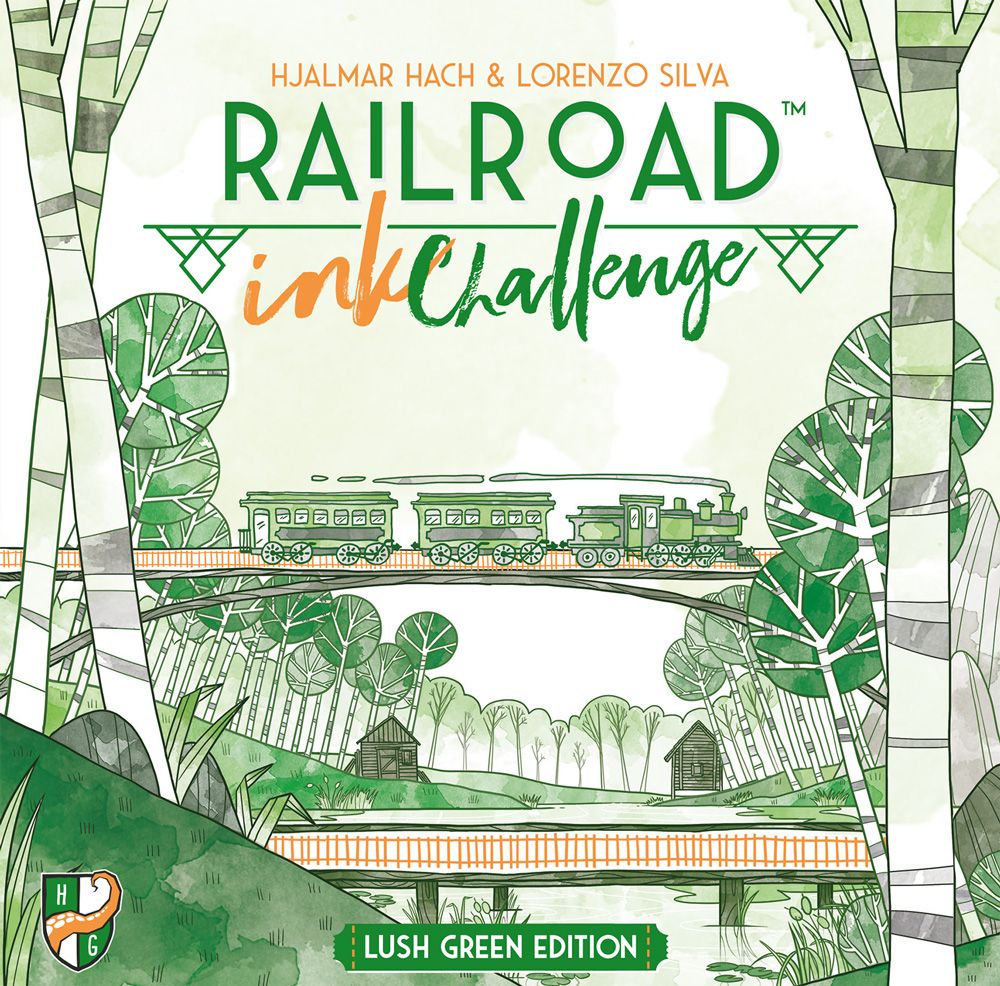
Railroad Ink Challenge is a route-drawing game over 7 rounds in which players try to connect Exits to each other by drawing Routes that form Networks. The more Exits linked to the same Network, the more points it is worth. Bonus points come from the Longest Railway, Longest Highway, Central Spaces, Villages, and Goals, and the player with the most points wins.
Preparação
- Each player takes a Board and a marker.
- Place the white Route dice in the middle of the table.
- Shuffle the Basic Goal cards and randomly draw 3, placing them in the middle of the table. Each player marks the code of each Goal in one of the Goal spaces on their board. Return unused Goal cards to the box.
- If playing with an Expansion, place the Expansion dice with the Route dice and replace 1 Goal card with a random Expansion Goal card.
To play without Goals, skip the Goal step and ignore Goal points at the end.
Um turno
At the start of each round, roll the Route dice once. All players must draw the Routes shown, at the same time, on their own boards.
Drawing rules:
- Each Route must connect on at least one side to an Exit or an existing Route. Routes that cannot connect cannot be drawn.
- Draw all 4 Routes shown on the dice if possible, each showing only once.
- Railways cannot connect directly to Highways; a Station is needed for that.
- Routes may be rotated and/or reversed.
Special Routes: each player may draw one Special Route per round, in addition to the dice Routes, and each may be used only once per game, up to 3 in total for the game. Mark them off when used.
Special Buildings: drawing certain Routes in a space with a Special Building triggers its effect immediately, or it is lost.
- Factory: when drawing a Route with at least 1 Railway and/or 1 Highway in its space, duplicate one of this round's dice Routes, drawing it twice this round.
- Village: when drawing a Route with a Station in its space, mark the leftmost unmarked Village space in the scoring area.
- University: when drawing a Route with at least 1 Railway and/or 1 Highway in its space, mark one University space. On the third and last University mark, draw 1 Special Route for free, which does not count toward the per-round or per-game limits.
After all players have drawn, check Goals and declare any achieved. Then, at the end of the round, each player writes the round number in the boxes of every space they drew on this round. Previously drawn Routes cannot be erased. Roll the dice to begin the next round.
Fim do jogo
The game ends after the 7th round.
Pontuação
Goals are scored during the game: at the end of each round, players declare Goals achieved and write the highest score still available for that Goal. If several players achieve the same Goal in the same round, they all get the same points. Mark the highest Score dot on the card after scoring, so later players get fewer points; the lowest score (1 point) is never marked.
At game end, each player counts:
- Connected Exits, by Network, using the Network Values on the board (for example, 4 Exits in one network is worth 12 points).
- Longest Railway and Longest Highway: 1 point per space with a part of the single longest unbroken line of that Route type, with spaces counted each time the line passes through them. Stations do not interrupt a line. If two longest lines have the same length, only one counts.
- Central Spaces: 1 point for each of the 9 central spaces that has any Route drawn on it.
- Villages: points equal to the value of the highest marked Village space.
- Goal points.
- Expansion points, if an Expansion is used.
- Errors: each Route end that does not connect to another Route or to the outer edge of the board is an Error, costing 1 point each.
Add everything up for the total. The player with the most points wins. Ties are broken by the fewest Error marks; if still tied, the victory is shared.
Variantes
Playing without Goals: skip the Goal setup and ignore Goal points during final scoring.
Solo mode: follows regular rules, except that Goals are Timed Goals. The Top Goal must be completed by the 3rd round, the Middle Goal by the 4th round, and the Bottom Goal by the 5th round. Completing a Goal before its time limit is worth 4 points; completing it after is worth 1 point.
Draft mode: requires one Railroad Ink box per player. Instead of a shared set of dice, dice are drawn from a common Dice Pool. Each round has three phases: rolling (roll 2 dice at a time into pairs until all dice are paired), drafting (players take turns picking pairs, two rounds of picks, so each gets a personal set of 4 dice), and drawing (players draw their own set). The first player for the next round is the one with the lowest total dice value, with ties going to the player who picked last. Ties at game end are won in reverse turn order, starting from the player to the right of the player with the star. Expansion dice are not drafted but shared by all players.
Expansions (marked with a star): the Forest and Trail Expansions each last 6 rounds and add their own scoring and Expansion Goal cards. Forest: up to 2 Forests scored, worth 2 points per space for the first and 1 for the second. Trail: connects Stations through Trails and scores half the Network Values for connected Stations, with a maximum of 12 Stations scored.
Alterações
- Variantes, por o rascunho do manual de regras, 23 de novembro de 2026 (mostrada agora)
- Pontuação, por o rascunho do manual de regras, 23 de novembro de 2026 (mostrada agora)
- Fim do jogo, por o rascunho do manual de regras, 23 de novembro de 2026 (mostrada agora)
- Um turno, por o rascunho do manual de regras, 23 de novembro de 2026 (mostrada agora)
- Preparação, por o rascunho do manual de regras, 23 de novembro de 2026 (mostrada agora)
- Resumo, por o rascunho do manual de regras, 23 de novembro de 2026 (mostrada agora)