Regras de Rook
Resumo
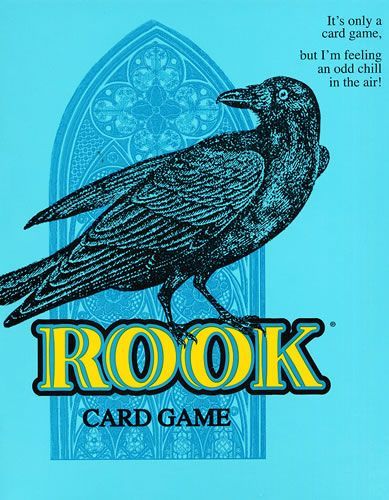
ROOK is a family of trick-taking card games played with one deck of 56 numbered cards in four colors (green, red, black, yellow), plus the special Rook Bird Card in many versions. In the bidding games, players bid for the right to name trump, then win tricks and count-card points. The first player or partnership to reach the game score for that version wins.
Preparação
- Choose a dealer: each player draws from the unexposed pack, and the highest card deals.
- Shuffle and cut, then deal every card, one at a time, clockwise starting left of the dealer. Some games also deal a separate hand called the "nest" face down in the center.
- Each player sorts their hand by color.
- The dealer role passes to the left after each hand.
Um turno
In a bidding game, bidding starts with the dealer or the player to the dealer's left, moving clockwise. Each player either bids higher than the last bid or passes, and a player who passes cannot bid again that hand. The highest bidder names the trump color, and may first swap cards with the nest where the game uses one.
The player to the left of the high bidder leads. Players must follow the led color if they can. If they cannot, they may play a trump, discard a card of another color, or play a card to help a partner. The highest card of the led color takes the trick unless a trump is played, in which case the highest trump takes it. The trick winner leads next.
The Rook Bird Card is the highest trump in most games and can be played at any time, regardless of the led color. In some games it must be played when trump is led and its holder has no other trump.
Fim do jogo
The game ends when a player or partnership reaches the game score for the chosen version, which ranges from 150 to 1,000 points. Usually several hands are needed. If both sides pass the game score in the same hand, the higher total wins. If they are tied, another hand is played.
In non-bidding games, the game ends when a player goes out, when the draw pile runs out, or after a set number of deals, depending on the game.
Pontuação
Count Cards are the 5s, 10s and 14s, worth 5, 10 and 10 points, and the Rook Bird Card, worth 20 points. Each player's score is the total of the Count Cards they captured. Tricks have no separate value in most games, though some versions add points per trick.
In the basic game, every hand totals 100 points, so a total other than 100 signals a scoring error. If the high bidder does not make the bid, they score nothing and are set back by the amount of the bid. Some versions double the opponents' score or add a bonus, such as for taking all tricks.
If both sides exceed the game score in the same hand, the higher total wins. A tie leads to another hand.
Variantes
The rulebook gives many versions, which fall into two groups.
Bidding games:
- Official Tournament Rules (four players, partnership, based on Kentucky Discard)
- The Red 1 (four players, partnership, with a 42-card deck and a 500-point game)
- The Regular Game (three to six players)
- 1-High Partnership (four players, the 1 is the highest card of each color)
- Dixie (four or six players, partnership)
- Display (four players, partnership, with a shown partner hand)
- Boston (four players, an advanced game with trick values set by trump color)
- Tennessee for Two and Over the Top (two players)
- The Regular Game for Two (two players)
- Three-Handed Partnership Display (three players)
- High Card Partner (five players)
- Partnership for Six (six players)
Non-bidding games:
- Club (four or six players, using two or three decks, with melding and discarding)
- Panjandrum (three to five players, building piles)
- Golden 10 (three to seven players, avoiding red cards)
- Tuxedo (two to six players, capturing cards)
- I Doubt It, Donkey and Clock Pastime (described in the rulebook)
Alterações
- Variantes, por o rascunho do manual de regras, 23 de novembro de 2026 (mostrada agora)
- Pontuação, por o rascunho do manual de regras, 23 de novembro de 2026 (mostrada agora)
- Fim do jogo, por o rascunho do manual de regras, 23 de novembro de 2026 (mostrada agora)
- Um turno, por o rascunho do manual de regras, 23 de novembro de 2026 (mostrada agora)
- Preparação, por o rascunho do manual de regras, 23 de novembro de 2026 (mostrada agora)
- Resumo, por o rascunho do manual de regras, 23 de novembro de 2026 (mostrada agora)