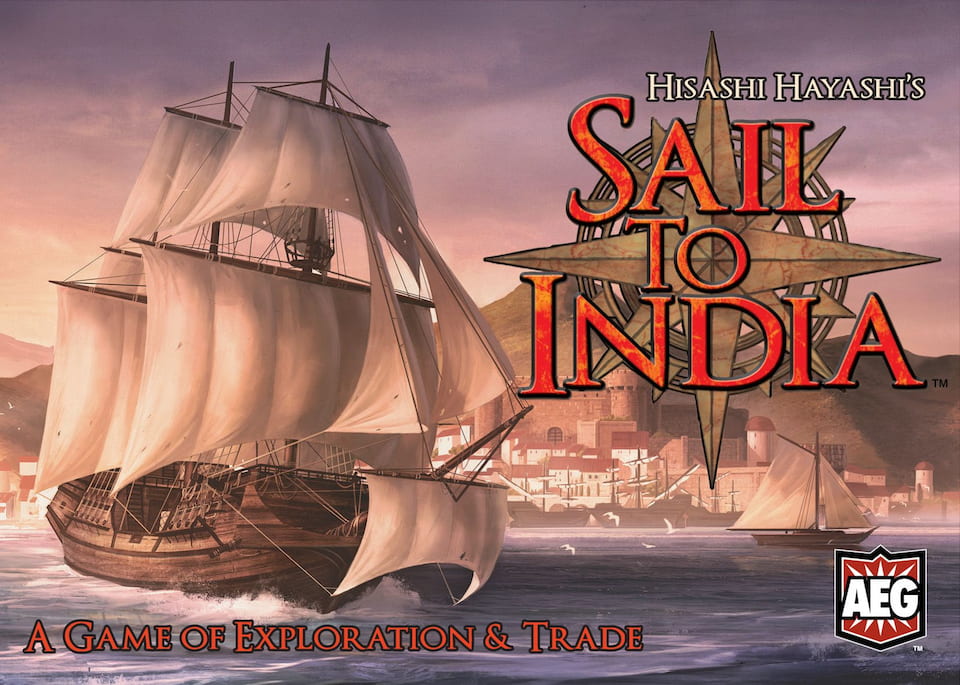
Regras de Sail to India

Resumo
Sail to India is a game for 3 to 4 players set in the Age of Discovery, where players are nobles backing Portuguese explorers. Players earn victory points (VP) by discovering coastal towns, selling trade goods, constructing buildings and acquiring technologies. The player with the most VP at the end of the game wins.
Preparação
- Each player takes a historian card, a domain card and a reference card. With three players, return the unused cards to the box.
- Line up the three technology cards where everyone can read them.
- Shuffle the twelve coastal town cards and place them facedown in a line, with the Lisboa card at the left end. Flip the three cards nearest Lisboa faceup. With three players, reveal and return the three rightmost cards to the box.
- Each player chooses a color and takes five markers of that color. Place one on Lisboa, one on the speed 1 space of the domain card and three on the technology (scientist) space. The rest form the stock.
- The player who most recently sailed on a boat starts. Going clockwise, players receive 2, 2, 3 and 4 wealth, placing each as a banker on the domain card.
For a first game, the rulebook suggests using the three recommended towns in the order given from Lisboa, then shuffling the rest into the line.
Um turno
Players take turns clockwise. On your turn you get two action points, and each action costs one point. You may repeat the same action twice. Choose from these:
- Employ marker: pay 1 wealth to move one marker from the stock to Lisboa.
- Move ships: move any number of your ships along the coastal towns, up to your ship speed in cards, toward or away from Lisboa. You may also move markers from Lisboa out as new ships. Entering a facedown town ends that ship's movement, flips the card and gains 1 VP (flipping India also gives 1 extra VP). Only one new town may be discovered per turn. Afterward, you may turn any ships into trade goods on one of the town's two trade spaces.
- Sell trade goods: return trade goods to Lisboa. The payout depends on how many different kinds you sell, from 1 kind giving 1 wealth up to 6 kinds giving 6 wealth and 4 VP.
- Build building: pay 2 wealth to turn a ship into a building on one of the town's two building spaces.
- Acquire technology: pay the listed wealth and move a scientist onto an unclaimed technology.
- Increase ship speed: pay 2 wealth to go from speed 1 to 2, or 4 wealth to go from 2 to 3.
At any time, without spending action points, you may return certain markers to Lisboa and use the effects of your technologies.
Fim do jogo
The game ends when either of these happens:
- The last coastal town (India) is discovered.
- Two or more players have no markers left in the stock.
The player who triggered the end finishes their turn. Each other player then takes one final turn.
Pontuação
Each player totals their VP:
- VP shown by markers on the historian card. A historian holds up to 5 VP, and every additional 5 VP requires another historian taken from Lisboa. Surplus VP is lost if none is available.
- 1 VP per marketplace and stronghold owned.
- 2 VP per church owned.
- Any end-of-game VP from technologies.
The highest score wins. Ties are broken by: first, who discovered India; second, who has the most wealth; third, who gained the most VP on the historian card. If still tied, the tied players share the win.
Alterações
- Pontuação, por o rascunho do manual de regras, 23 de novembro de 2026 (mostrada agora)
- Fim do jogo, por o rascunho do manual de regras, 23 de novembro de 2026 (mostrada agora)
- Um turno, por o rascunho do manual de regras, 23 de novembro de 2026 (mostrada agora)
- Preparação, por o rascunho do manual de regras, 23 de novembro de 2026 (mostrada agora)
- Resumo, por o rascunho do manual de regras, 23 de novembro de 2026 (mostrada agora)