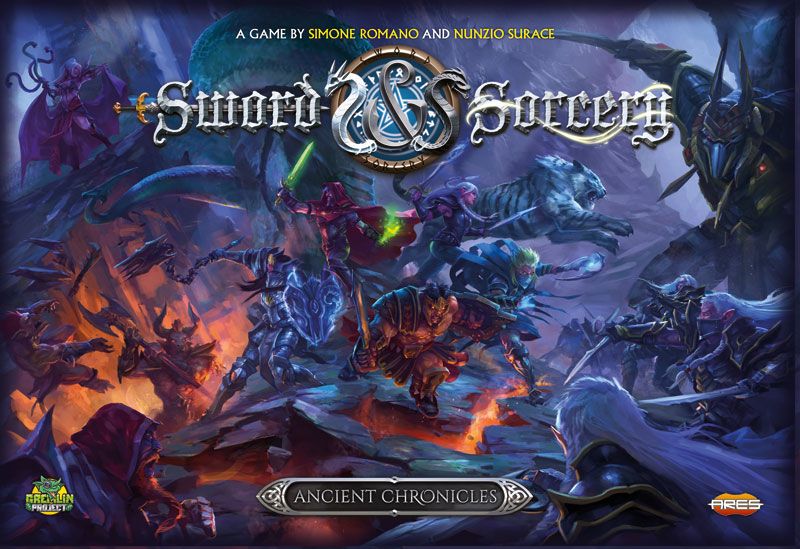
Regras de Sword & Sorcery: Ancient Chronicles
Resumo
Sword & Sorcery is a cooperative fantasy board game for 1 to 5 players. Each player controls a Hero who fights Enemies through a series of Quests to save the kingdom and free their souls. Heroes grow stronger by gaining Soul Points and raising their Soulrank. This rulebook part does not state a single overall win condition; each Quest sets its own victory and failure outcomes.
Master Enemies are the toughest foes in the game. Each one is a large purple figure with one big card that combines the Enemy Scroll and Enemy card of a standard Enemy. The card has two sides, often with different A.I. behavior, so each side must be read carefully.
Preparação
Sort the cards into their decks as suggested, and shuffle the decks that need it.
Build the battlefield, tokens, and decks as the Quest Setup section of the Storybook describes. Each player chooses or randomly selects a Hero card, then takes the matching Hero Sheet, Soul Gem, and figure. Depending on the Quest, the party may start with shared Soul Points and Crowns.
Each Hero starts at full health. The rulebook gives a minimum of 2 Heroes. A player controlling several Heroes must act with each one independently.
When a Master Enemy enters play, place its card where every player can easily reach it. Its Menace token starts on Level I with the Active player, who becomes the Menacing Hero.
Um turno
Each Round has three phases.
- Time Phase: apply effects and cleanup, refresh used powers, reduce cooldowns, and spend shared Soul Points to raise Soulrank or resurrect a Ghost Soul at an open Shrine.
- Battle Phase: each player takes a Hero Turn, then an Enemy Turn, in any order. On a Hero Turn, the Hero may use one Movement activity, a number of Combat activities and Action activities set by Soulrank, and any number of Free Actions. On an Enemy Turn, the active player draws an Encounter card to activate Enemies if any are in play. Minions act each Enemy Turn.
- Event Phase: if the top Event card is face down, draw and resolve it. If it is face up, discard it.
Rounds repeat until the Quest ends.
The Master Enemy always activates as if it were assigned to the Active player, and this changes from player to player. When a player must activate an Enemy, they apply the Master Enemy's A.I. as if it were theirs.
Most Master Enemies have the Vengeful power, which uses the Menacing Hero system. Its A.I. only considers the distance to the Hero holding the Menace token and ignores other possible victims. Other Heroes may be damaged only when the card names them, such as "attack the closest Hero in L.O.S."
The Menace token moves as follows:
- If the Menacing Hero wounds the Master Enemy, the token is flipped to Level II.
- If another Hero wounds it, the token drops to Level I. If it is already at Level I, it passes to that Hero, who becomes the new Menacing Hero.
- A Taunt effect, or any equivalent, moves the token to the power's owner at its current level.
- If the Menacing Hero dies or cannot be targeted directly, the controlling player gives the token to another Hero if possible. Otherwise it stays put, and that Hero cannot be attacked until targetable again.
Targeting happens at the start of the Enemy's activation, and the chosen behavior is followed even if conditions change. Some Master Enemies use the Spell token, which is tossed to select the active power effect. The Menace token is tracked even when a side lacks Vengeful, since it still determines the victim by the normal system.
Fim do jogo
The Quest ends immediately when a victory or failure condition is met. The Heroes usually fail when the last Event card is discarded from the Event deck, or when all Heroes are in Ghost Soul form. Other conditions are revealed by Story Events and Waypoints in the Quest materials.
Variantes
The rulebook marks sections containing variations from the Immortal Souls saga ruleset with an icon. Heroes from that saga may be used in this campaign, with Treasure cards from its expansions following the rules given for ACT I and ACT II treasures.
Alterações
- Variantes, por o rascunho do manual de regras, 23 de novembro de 2026 (mostrada agora)
- Fim do jogo, por o rascunho do manual de regras, 23 de novembro de 2026 (mostrada agora)
- Um turno, por o rascunho do manual de regras, 23 de novembro de 2026 (mostrada agora)
- Preparação, por o rascunho do manual de regras, 23 de novembro de 2026 (mostrada agora)
- Resumo, por o rascunho do manual de regras, 23 de novembro de 2026 (mostrada agora)