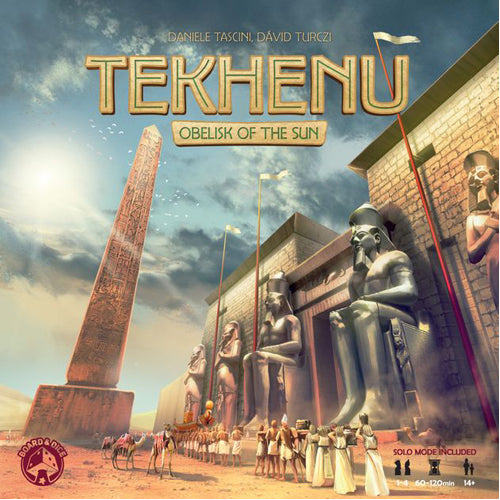
Regras de Tekhenu: Obelisk of the Sun
Resumo
In Tekhenu: Obelisk of the Sun, players are Egyptian nobles building the Temple of Amun-Ra and the district of Ipet-Isut. Each turn they take dice from around the rotating Obelisk Wheel to perform god actions or produce resources, while keeping their scales balanced to avoid losing Victory Points. After two Scorings, the player with the most Victory Points wins.
Preparação
- Place the main board, then the Obelisk Wheel in a random position through the Obelisk. Place the two Scoring markers on the wheel as shown in the rulebook.
- Set the Pillar tiles face down by the Ra area and reveal 3 on their spaces. Shuffle the Horus Bonus tiles and place one on each Horus space.
- Put the resources, Scribes and Faith in a general supply. Place 1 Gold on each of the two Temple Complex statue spaces, the two Osiris statue spaces, and beside the second row of the Osiris area.
- Fill the draw bag by player count: with 4 players use all dice; with 3 players remove the 2 gray dice; with 2 players remove one each of yellow, brown, white and black, keeping gray.
- For each wheel section, draw and roll 3 dice and place each in the row matching whether it is Pure, Tainted or Forbidden.
- Each player takes a board and the pieces of one color: 10 Buildings, 6 Statues and 8 Pillars beside the board, one Maat marker, a Victory Point marker on 10, Happiness on 2 and Population on 5, and production markers on 2. Each takes 1 Gold and 1 Scribe.
- Shuffle the Blessing, Technology and Decree decks. Fill Card Market sections 1 and 2 (1 Blessing and 1 Technology in section 1; 2 Blessings and 2 Technologies in section 2). Leave sections 3 and 4 empty.
- Deal 2 Decrees to each player; each keeps one and returns the other to the bottom of the deck.
- Shuffle the Starting cards and show as many as there are players plus one, along with the 4 Destiny cards. Choose a random starting player, then draft one Starting card each in turn order, followed by a second in reverse order.
- Set turn order by the total initiative on each player's two Starting cards, highest first; ties go to the higher single initiative value.
- In turn order, each player takes a Destiny card and receives the rewards on their Starting and Destiny cards. Return the Starting cards to the box.
Um turno
On your turn, take exactly one Pure or Tainted die from around the wheel. You may not take a Forbidden die. Put it on your scales: Pure on the left, Tainted on the right. Then choose one:
- Perform the god action of the section you took the die from.
- Produce the resource matching the die color, in a quantity equal to the die value. Gray dice cannot be used to produce. Any amount above that color's production marker goes to the right side of the scales as Taint.
Scribes can be used in two ways:
- Spend 1 Scribe per step to raise or lower the die value by 1 or 2 (values wrap around 1 and 6).
- Spend exactly 2 Scribes for an Anubis action: use any die from anywhere, including a Forbidden one, for any action. Place that die under the scales; it does not count toward the balance.
After your action:
- If you are last in turn order and have exactly 2 or 4 dice on your board, a Rotation happens.
- If you are last but do not meet that count, begin a new round.
- Otherwise, the turn passes to the next player.
Rotation: rotate the wheel one section clockwise, add dice equal to the number of players to each of the two shaded sections, and sort all dice into their correct rows. If every player has 4 dice, a Maat phase follows first. Rounds are grouped so that 2 rounds make a Rotation, 2 Rotations make a Maat phase, and 2 Maat phases make a Scoring.
Maat phase: each player totals the balance of their scales (Pure dice count positive, Tainted dice and excess resources count negative), then uses Faith tokens to offset imbalance. Move Maat markers to match balances. Players with negative balances lose Victory Points according to the table: -1 to -2 costs nothing, -3 to -5 costs 1, -6 to -8 costs 2, and -9 or lower costs 3. Turn order is reset by balance in ascending order, with ties going to the higher Ankh value. Then clear the boards, return the dice to the bag and Faith to the supply, and each player takes a Destiny card in the new order. If the wheel arrow points at the lowest-numbered remaining Scoring marker, a Scoring follows; otherwise play resumes with the Rotation.
Fim do jogo
The game ends after the second Scoring. Each player then reveals their Decrees and scores them, subject to the limit of up to 3 Decrees with no two of the same symbol.
Pontuação
A Scoring happens during the second Maat phase when the wheel arrow reaches the Scoring marker.
1. For each of the four Resource districts in the Osiris area, the player with the most Buildings and Statues there scores 3 Victory Points. Ties go to the player whose piece is topmost.
2. For each player, score the Temple Complex: 1 Victory Point per Building and Statue there, plus 1 Victory Point per Pillar for each of that player's Buildings and Statues in the same row or column.
3. Score 1, 3, 6, 10, 15 or 21 Victory Points for having built 1 to 6 Statues.
4. Score 3 Victory Points for each Happiness step reached on the Populace track, counting only the highest step reached.
5. Score 2 Victory Points for each production marker at position 6.
6. Score the Victory Points shown on the Building row of your board.
7. Pay the Bread shown on the Building row. For each Bread you cannot pay, lose 3 Victory Points. Victory Points cannot go below zero.
After the Scoring, remove its marker. After the final Scoring, also score the Decrees and the following: the player first in turn order scores 3 Victory Points, and in 3- or 4-player games the player second in turn order scores 2.
The player with the most Victory Points wins. Ties are broken by the most Scribes, then by the player earlier in turn order.
Variantes
Solo mode (Botankhamun): you play against an automated opponent, Botankhamun. Setup changes include a Destiny card choice that is random for Botankhamun, no player board for Botankhamun, and Botankhamun starts with 4 Happiness and 7 Population. Botankhamun uses 10 Action tiles arranged in a pyramid, moved by flipping the Deben token. Each tile tells it which god action to take with the highest matching die. Its Horus, Ra, Hathor, Bastet, Thoth and Osiris actions follow separate rules, and it never pays costs or produces resources. In scoring, Botankhamun scores Decrees at 4 Victory Points each (or 8 on the harder setting), and every two Scribes are worth 1 Victory Point. Difficulty can be raised by starting Botankhamun with extra buildings, a Pillar, or a Statue. Starting cards can also be drawn randomly for an added challenge.
Two-player game: remove Technology T16 and Decree D01 from the game. Certain Statue spaces are unavailable, and bonuses from a Statue built in honor of a god are received when either player performs that action.
Alterações
- Variantes, por o rascunho do manual de regras, 22 de novembro de 2026 (mostrada agora)
- Pontuação, por o rascunho do manual de regras, 22 de novembro de 2026 (mostrada agora)
- Fim do jogo, por o rascunho do manual de regras, 22 de novembro de 2026 (mostrada agora)
- Um turno, por o rascunho do manual de regras, 22 de novembro de 2026 (mostrada agora)
- Preparação, por o rascunho do manual de regras, 22 de novembro de 2026 (mostrada agora)
- Resumo, por o rascunho do manual de regras, 22 de novembro de 2026 (mostrada agora)