Regras de The Estates
Resumo
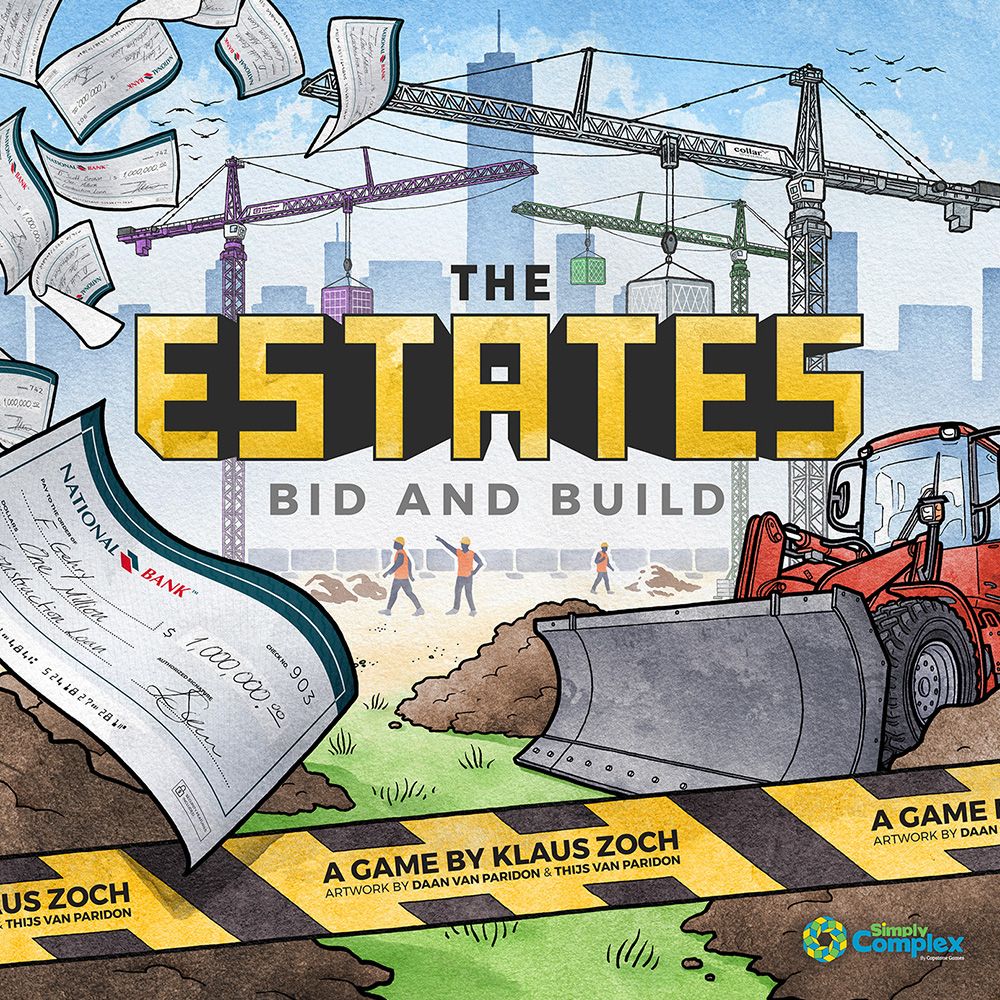
The Estates is an auction game about developing a new urban area. Players bid for wooden pieces and place them to build up three rows of buildings. The player with the highest score at the end of the game wins.
Preparação
- Place the game board in the middle of the table and the six Company Certificates near Main Street.
- Put all 36 Floor cubes in a linen bag, then draw 24 at random and arrange them numbered side up in 3 rows of 8 beside the board. Return the other 12 to the box.
- Shuffle the 12 Rooftops face down near the board.
- Place the 3 Building Permits, the Cancel cube and the Mayor near the board.
- Give each player $12 million in Checks.
- Choose the starting player at random.
Um turno
The active player may first set aside $1 million of their Checks as Illegal Earnings. These go into a hidden personal cash box and cannot be used for bidding for the rest of the game.
The active player then chooses one available piece and auctions it. Pieces are available if they are not on the board and have not been discarded. Floor cubes can be taken from either end of the 3 rows. A Rooftop can be taken only if a finished-less building lacks one and Rooftops remain; flip it over before the auction.
Auction: starting with the player to the auctioneer's left, players bid clockwise. The first bid may be any whole-dollar amount, and each later bid must be higher. Each player bids once or passes, and passing ends their participation. Illegal Earnings cannot be bid. When all have bid or passed, the auctioneer either gives the piece to the highest bidder, who pays the auctioneer, or keeps the piece and pays the highest bid to that bidder. If everyone passes, the auctioneer takes the piece for free.
The winner must place the piece immediately or it is removed from the game. Floor cubes and Rooftops are placed on the board. Permits, the Mayor and the Cancel cube must be placed or used right away or they are removed. The next player clockwise then takes the turn as auctioneer.
Placing Floor cubes: each row holds up to 4 buildings. The first cube in a row goes on the lot next to the street. Later cubes go on top of or next to cubes in the same row, with no empty lots between buildings. A cube placed on another must have a lower number than the cube beneath it, up to 6 per lot. Lots with white dirt take only 1 cube. Players cannot build on or past a Building Permit, and cannot place cubes on a Rooftop. The first cube of a color taken by a player earns that player the matching Company Certificate.
Placing a Rooftop: put it face up on a Floor cube without one, which completes that building.
Placing a Building Permit: put it on an empty lot in the chosen row to set the row's new length. The permit shortens or lengthens the requirement by 1, 2 or 3 buildings. A new permit in a row replaces the old one's position. A permit cannot shorten a row below the number of lots already developed.
Placing the Mayor: put it on Main Street in front of one row.
Using the Cancel cube: discard one placed Building Permit. Adjust the row's requirement to match, or return it to the original 4 lots if no permits remain in that row. A lengthening permit cannot be removed if that would make the row shorter than what is already developed.
Fim do jogo
The game ends when either:
- 2 rows are completed, meaning they fill their required length and every building in them has a Rooftop; or
- no more buildings can be completed because no Rooftops or Floor cubes remain.
Pontuação
Buildings in completed rows score positive points. Buildings in incomplete rows score negative points. A row may have no completed rows at all.
A building scores only for the owner of the Company Certificate matching the color of its topmost Floor cube. Each Floor cube in that building scores its printed value for its owner, and the Rooftop value is added. The Mayor doubles the scores, positive or negative, of every building in its row.
Each Check in a player's personal cash box is worth 1 point. The player with the highest score wins. A tie is broken by the tied player holding the most Checks, counting their personal cash box.
Variantes
Several rounds: the group agrees on the number of rounds before starting. A round takes about 45 minutes. Record each player's score after every round. After the last round, the highest total wins. If a player wins 2 rounds, the game ends and that player is the final winner. If every player's total is negative, the player with the least negative total wins.
Between rounds, set up the game as usual but skip setup step 6, so players keep their Checks from the previous round, including their personal cash box.
Alterações
- Variantes, por o rascunho do manual de regras, 22 de novembro de 2026 (mostrada agora)
- Pontuação, por o rascunho do manual de regras, 22 de novembro de 2026 (mostrada agora)
- Fim do jogo, por o rascunho do manual de regras, 22 de novembro de 2026 (mostrada agora)
- Um turno, por o rascunho do manual de regras, 22 de novembro de 2026 (mostrada agora)
- Preparação, por o rascunho do manual de regras, 22 de novembro de 2026 (mostrada agora)
- Resumo, por o rascunho do manual de regras, 22 de novembro de 2026 (mostrada agora)