Regras de The Princes of Machu Picchu
Resumo
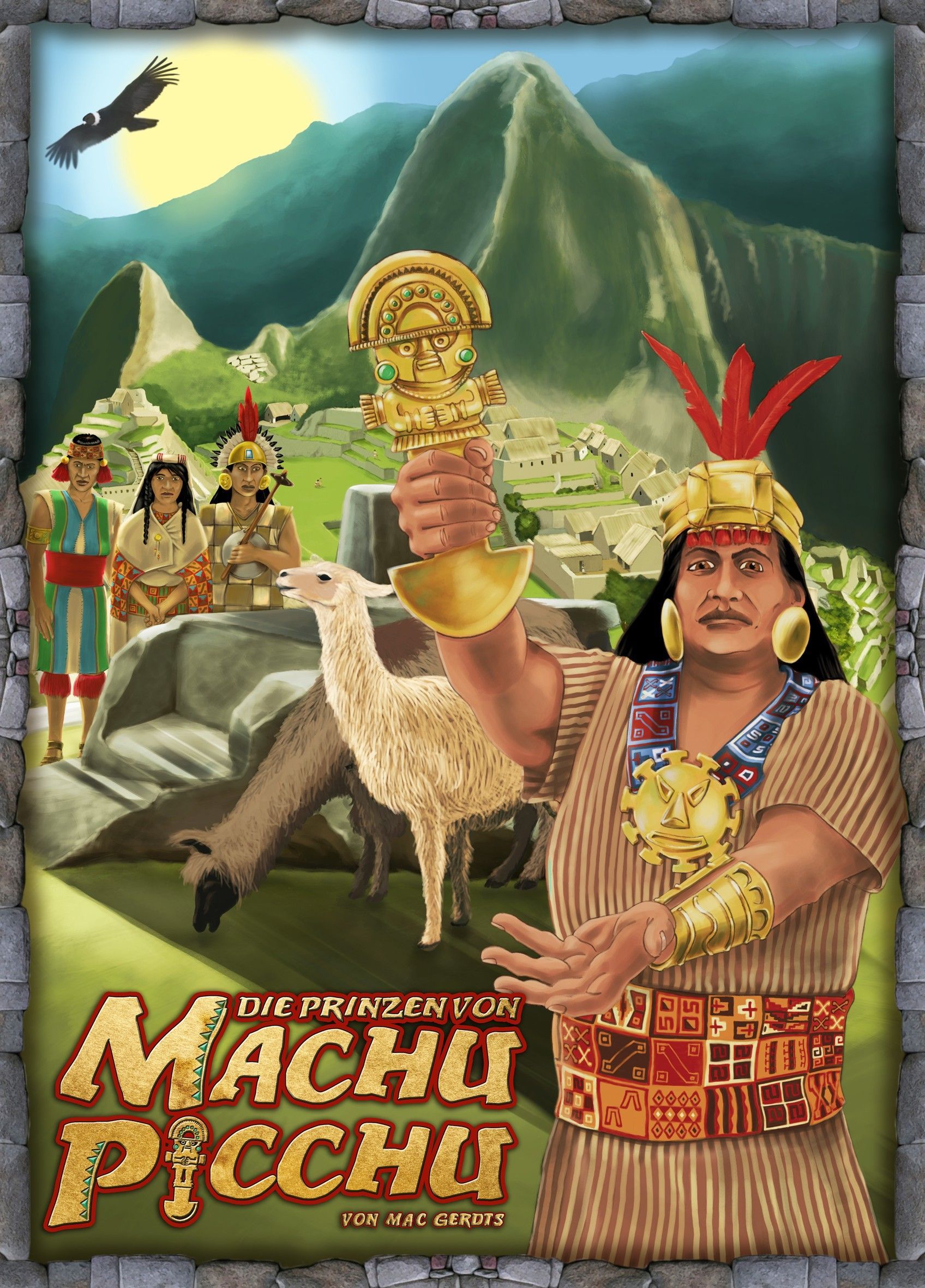
The Princes of Machu Picchu is a worker-placement style game in which players direct their Princes around the districts of Machu Picchu to produce goods, set up Incas, acquire Priests and Virgins, and advance their Scouts along the Incatrail. Advancing a Scout earns Sacrifice Cards, which bring victory points. The game ends either when all Priests and Virgins are acquired or the Sacrifice Cards run out (the rescue), or after day 9 if the Spanish conquer the city. The player with the most victory points wins, with gold-based multipliers applied in a Spanish conquest.
Preparação
Place the 15 Priest and Virgin cards on their spaces on the board and fill the market with 8 goods, two of each type in the top two fields of each column. Shuffle the 28 Sacrifice Cards and place them face down. Put the Sun Tile on the moon in the sky and keep the 7 Moon Tiles nearby.
Place one temple stone on each of the 4 temples. Place one bonus unit on each of the 5 production districts: 3 corn (counting as one unit) in the Corn Terraces, 1 llama, 1 coca, 1 pottery and 1 cloth in their matching districts. Put the orange time marker on day 1 with 2 players, day 2 with 3 players, or day 3 with 4 or 5 players. Place 1 corn on each moon symbol on the time track ahead of the marker.
Each player takes their 2 game stones (Scout and Prince), and an Incas supply based on player count: 12 for 2 players, 10 for 3, 9 for 4, 8 for 5. Each player also receives 3 corn, 1 llama, 1 coca, 1 pottery and 1 cloth, and secretly draws 1 Sacrifice Card. Remaining goods form the bank's supply.
Choose a starting player at random. Starting with that player and going clockwise, each player places their Scout on the Incatrail: the starting player on field 1, the next on field 2, and so on. Then, in the same order, each player places one Inca on the board in any of the five occupations (Farmer, Shepherd, Coca Planter, Potter or Weaver); occupations may repeat. The starting player then places their Prince on any district and performs its action.
Um turno
On your move, do one of the following:
- Move your Prince to an adjacent district.
- Pay 1 llama to move your Prince to any other district.
- Stay in your current district and take a Moon Tile from the board. The district's action is not triggered.
When a Prince enters a district, the district's action happens. A Prince cannot use the same district on two consecutive turns, even by paying a llama.
Production districts (Corn Terraces, Llama's Meadow, Coca Plantation, Potter's Quarter, Weaver's Quarter): the Prince collects all bonus units there. Then every Inca in that district may produce once. Farmers make 3 corn for free. Other Incas pay 1 corn to the bank and produce 1 good matching their profession. Incas only produce where a bonus is present, and they may skip production.
Temples (Condor, Puma, Sun, Main): the Prince collects all temple stones there and the Scout advances 3 steps per stone. Sacrifices then happen in seating order starting with the current player, but only if the temple had at least one stone. At the Condor, Puma and Sun temples, Priests or Virgins of that temple pay 1 llama each to advance the Scout by the lowest visible number for that type. At the Main Temple, any player may sacrifice up to one each of different goods (3 corn counts as one good), advancing 2 steps per good.
Watchman's Hut and Royal Palace: pay the listed goods to the bank to place a new Inca from your supply. Farmers and Shepherds are set up at the Watchman's Hut; Coca Planters, Potters and Weavers at the Royal Palace. Only one Inca per district can be set up per turn.
House of Priests and House of Virgins: pay the cost printed on a Priest or Virgin to the bank and take the leftmost one of that type. Only one may be acquired per turn.
Central Plaza: trade with the bank at market prices. Before trading you may add or remove one unit from the market. Selling places goods on the highest free price; buying takes the lowest available unit. Empty columns are bought from the bank at 6 corn each, and full columns sold to the bank at 3 corn each.
Sun Clock: place one of your Incas from another district here until the next night.
The Incatrail: a Scout reaching step 7 (Granary) gets 3 corn, step 13 (Llama Stable) gets 1 llama. Reaching step 20 gives a Sacrifice Card: draw 3, return 2 to the bottom of the stack. Any goods gained on the Incatrail are paid at the end of the turn, so they cannot be used for a sacrifice in the same turn.
Day ends when the third Moon Tile is taken: the player who took it takes the Sun Tile. Each other player then takes one final turn, and the last player advances the time marker's moon symbol. Night then follows: Moon Tiles are returned and paid out (2 or 3 steps, or goods at 1 corn each except for the 3 corn tile), Incas at the Sun Clock return to supply with 3 different goods and 3 steps each, and bonus units are added (one temple stone per temple and one unit per production district, max two per district). The time marker moves to the next day, and the Sun Tile returns to the moon.
On day 9, the Moon Tile bonus and Sun Clock payouts are made immediately, and Sun Clock Incas stay there until the end.
Fim do jogo
The game ends in one of two ways.
Rescue: the game ends immediately after the turn in which the last Priest or Virgin is acquired, or when the stack of 28 Sacrifice Cards runs out. If more players are entitled to a card than remain, those players get 3 victory points instead.
Spanish Conquest: if neither rescue occurs, the game ends after day 9. After the third Moon Tile is taken on day 9, the other players take one final turn, and then the Spanish conquer the city at night.
Pontuação
Victory points come from Sacrifice Cards. Each icon on your cards scores 1 point for each matching Inca in the district or each matching Priest or Virgin you own, as printed on the card. Scouts also score extra points: 1 point for reaching the Granary (steps 7 to 12), and 2 points for reaching the Llama Stable (steps 13 to 19).
Rescue: the player with the most victory points wins. Ties are broken by the number of remaining goods (3 corn counts as one unit).
Spanish Conquest: victory points are calculated as above, then multiplied by gold. Gold is shown in the upper-right corner of the Sacrifice Cards, and Scouts reaching the Granary or Llama Stable add their gold too. The player with the most gold triples their points, and the player with the second most doubles theirs. Ties in gold share the multiplier of the next position: if several players are tied for the most gold, all of them triple, and if several are tied for second, all of them double. Other players keep their points. The highest final score wins, and ties are again broken by remaining goods (3 corn counts as one unit).
Alterações
- Pontuação, por o rascunho do manual de regras, 23 de novembro de 2026 (mostrada agora)
- Fim do jogo, por o rascunho do manual de regras, 23 de novembro de 2026 (mostrada agora)
- Um turno, por o rascunho do manual de regras, 23 de novembro de 2026 (mostrada agora)
- Preparação, por o rascunho do manual de regras, 23 de novembro de 2026 (mostrada agora)
- Resumo, por o rascunho do manual de regras, 23 de novembro de 2026 (mostrada agora)