Regras de Timbuktu
Resumo
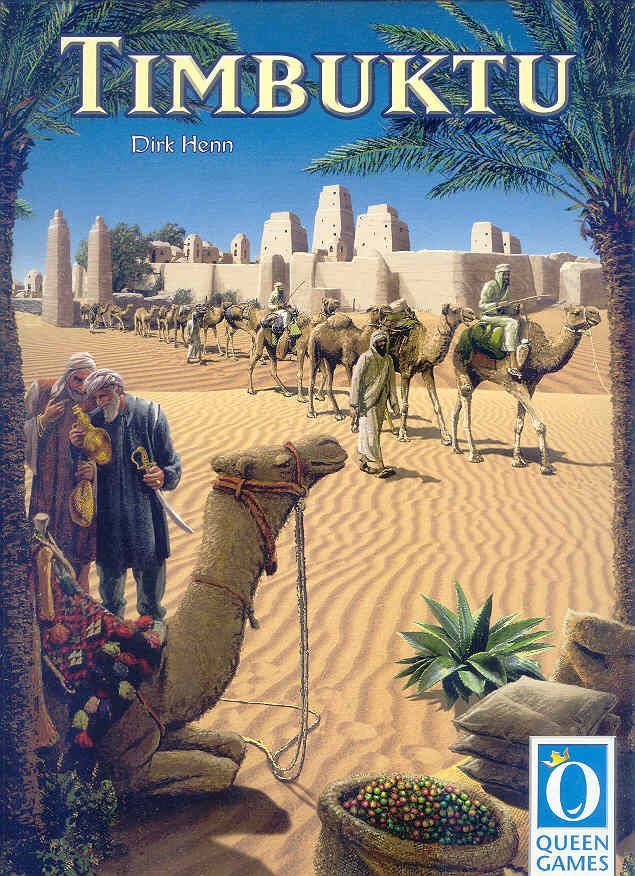
Players move caravans of camels carrying goods across a chain of oases to Timbuktu, while thieves in each oasis try to steal those goods. Thief cards give only partial hints about what will be stolen. The player whose delivered goods are worth the most points wins.
Preparação
Each player takes a caravan board, camels and camel cards in one colour, then places goods on the camels following the printed symbols. With 5 players use camels A-E, with 4 use A-F, and with 3 use all eight. Set aside unused camels and their cards. Lay out the route with the starting board, the oases in a chain, and the Timbuktu destination last. With 3 players remove both small boards, with 4 remove one small board, and with 5 use all boards. Going clockwise, each player places one camel on any free starting position, so every pen holds at least one camel from each player. Each player gets paper and a pencil. The oldest player is the starting player and takes the stage and round counters. Sort the thief cards by back into pen, pitch and goods piles, shuffle each pile, and deal five face-down piles of three cards, one of each kind. With 5 players each player takes one pile. With 4 players the spare pile goes between the starting player and the right-hand neighbour. With 3 players the starting player places one spare pile between himself and each neighbour.
Um turno
The game is played in stages, each covering one leg from one oasis to the next. A stage has three parts: dealing the thief cards, moving the camels, and thefts. In each round, every player secretly chooses a camel and plays its card face down. Then the cards are revealed one at a time, starting with the starting player, and each chosen camel moves into a pen at the next oasis. The camel takes the lowest-numbered free pitch in that pen. Only one camel fits on a pitch, and a camel cannot enter a pen with no free pitch. Moving in the direction of the two arrows is free. Moving into any of the other three pens costs one good from that camel, placed beside the board. A camel with no goods can still enter any pen but pays nothing. If a camel lands on a swap field, each player passes his pile of thief cards to his left-hand neighbour, and unassigned piles move on too. Players then update their notes. When all camels have moved, the round ends and the starting player passes the round counter to his left-hand neighbour, who starts the next round. After the last round of the stage, the thieves strike: all five piles are turned over one by one. Each card names a pen, pitch and goods type. Every camel on that pitch in that pen loses all goods of that type. Camels without that type lose nothing. Stolen goods are placed face up by category beside the board. At the start of the next stage, the stage counter passes to the next player clockwise, who also takes the round counter and starts. The thief cards are then collected, reshuffled and dealt again as at the start.
Pontuação
Each good that reaches Timbuktu is worth points equal to the number of goods of that type already removed from the game, whether stolen or paid as movement costs. A player's total is the sum of these values. The player with the most points wins. If points are tied, the player with more individual goods wins. If still tied, the tied players share the victory.
Variantes
Distribution of goods at the start: each player receives a fixed number of goods in each of the five categories. With 5 players that is 4 per category (20 total). With 4 players it is 5 per category (25 total). With 3 players it is 7 per category (35 total). Players use the reverse side of their caravan board, which has no printed goods, and allocate their goods to camels, with each camel carrying 4 goods drawn from three or four different categories. Leftover goods are removed from the game: with 4 players each player has 1 left over, and with 3 players each player has 3 left over. The rest of the game is unchanged.
Alterações
- Variantes, por o rascunho do manual de regras, 23 de novembro de 2026 (mostrada agora)
- Pontuação, por o rascunho do manual de regras, 23 de novembro de 2026 (mostrada agora)
- Um turno, por o rascunho do manual de regras, 23 de novembro de 2026 (mostrada agora)
- Preparação, por o rascunho do manual de regras, 23 de novembro de 2026 (mostrada agora)
- Resumo, por o rascunho do manual de regras, 23 de novembro de 2026 (mostrada agora)