Regras de Troyes Dice
Resumo
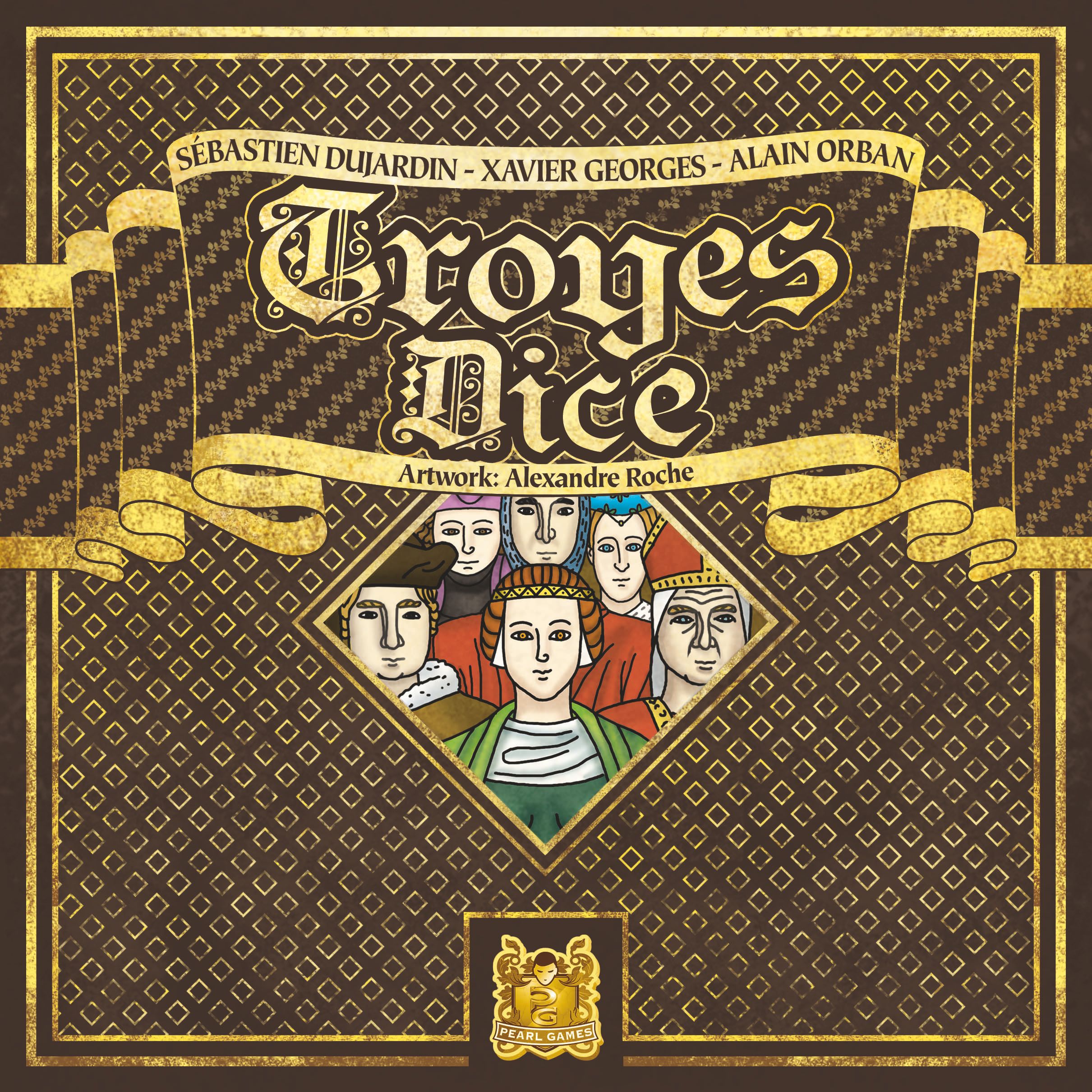
Troyes Dice is a dice-drafting game set in medieval Troyes, where players use dice on a rotating wheel to gain resources and citizens and to construct buildings across three districts over eight days. The player with the most victory points at the end of the game wins.
Preparação
Place the wheel in the middle of the table and put the 9 Plaza tiles, randomly flipped, into random notches of the wheel's large layer. Turn the small layer so day 1 shows in the neutral window. The player who most recently won a game becomes the town crier and takes all 4 dice, keeping them for the whole game. Give each player a scoresheet and a pencil. Each player numbers the columns of their three districts: for a first game use 1 to 6 left to right; afterwards the town crier rolls a die for the leftmost value and chooses whether numbers increase or decrease to the right, with every player using the same numbering. Each value 1 to 6 must appear once per district and all three values in a column must match. Expert mode lets the town crier place the numbers freely.
Um turno
At the start of each half day the town crier rolls all 4 dice, sorts them smallest to largest and places them on the plazas for that half day: the light plazas in the morning, the dark plazas in the afternoon. The lowest die goes on the 0-cost plaza and the others follow clockwise in increasing value; a black die sits before a transparent die of the same value. Next, the black die destroys the plaza it sits on, pulled from the wheel. From the third day, the black die's value and the destroyed plaza's color also cross out one matching die on every scoresheet, unless it is already crossed out or the column is protected by a Fortress.
Then all players simultaneously choose one transparent die from the three remaining plazas, paying its cost in deniers if shown. Dice can be shared. If a player cannot pay for any die and none is free, they instead gain one of each resource.
Actions:
1. Gain resources: circle resources equal to the die value. Red dice give influence, yellow dice give deniers, white dice give knowledge. Influence adjusts the die value by 1 each, knowledge changes die color for 2 each, and gained citizens are circled on their tracks.
2. Construct a prestige building: a red die builds a Fortress, a yellow die a Great Hall, a white die a Cathedral. Fortresses protect the column and give a citizen; Great Halls give resources based on the dice available; Cathedrals unlock endgame scoring for a building type, with the number written depending on how many Cathedrals have been built (1 for the first two, 2 for the next two, 3 for the last two).
3. Construct a work building: a red die builds the Count's Palace, a yellow die City Hall, a white die Bishopric. You gain two citizens of that color. Link bonuses are earned when both linked buildings are drawn.
At the end of each half day, the destroyed plaza is flipped to its other side and returned. At the end of each day, the small layer of the wheel turns one step clockwise to show the next day.
Fim do jogo
The game ends after the eighth afternoon.
Pontuação
Each Cathedral's endgame bonus gives its chosen number of VP for every drawn building of that type. Each pair of identical unspent resources earns 1 VP. Each circled citizen on the three citizen tracks earns 1 VP. Add these totals for the final score. The player with the most VP wins; tied players share the victory.
Variantes
Expert mode: the town crier chooses where each column number goes instead of rolling. Banquets and Raids expansion: take 3 random expansion tiles and place them Banquet side up beside the Plaza tiles whose front and back colors match, returning the rest to the box. Each tile's effect applies when its plaza's die is chosen. When the black die destroys that plaza, the tile flips to its Raid side, which has a negative effect for the rest of the game.
Alterações
- Variantes, por o rascunho do manual de regras, 23 de novembro de 2026 (mostrada agora)
- Pontuação, por o rascunho do manual de regras, 23 de novembro de 2026 (mostrada agora)
- Fim do jogo, por o rascunho do manual de regras, 23 de novembro de 2026 (mostrada agora)
- Um turno, por o rascunho do manual de regras, 23 de novembro de 2026 (mostrada agora)
- Preparação, por o rascunho do manual de regras, 23 de novembro de 2026 (mostrada agora)
- Resumo, por o rascunho do manual de regras, 23 de novembro de 2026 (mostrada agora)