Regras de Virgin Queen
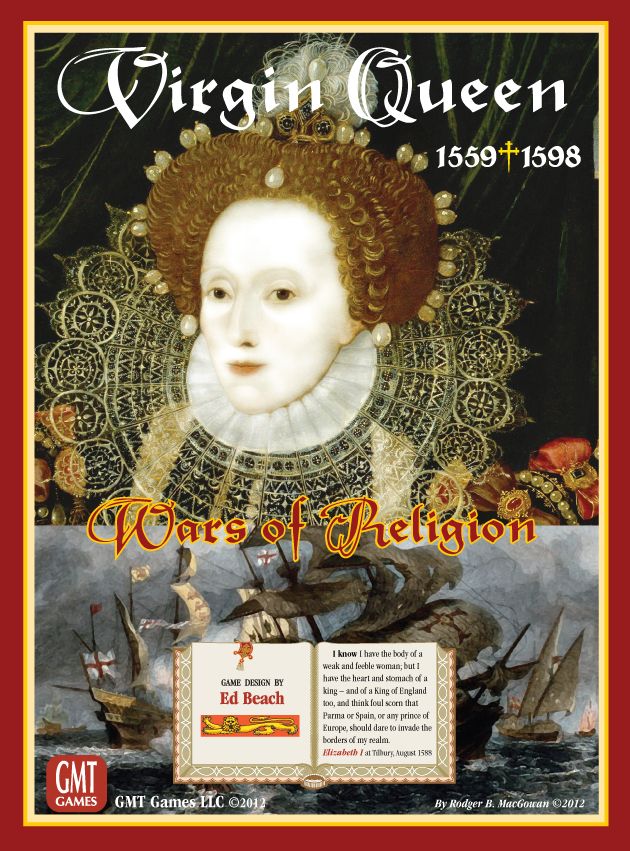
Resumo
Virgin Queen is a game for two to six players about the military, political and religious conflicts in Europe during the reigns of Elizabeth I of England and Philip II of Spain. Each player controls one or more of the six major powers. Players earn victory points through play, and a winner is checked at the end of each turn.
Virgin Queen: Wars of Religion is a game of European power struggles from 1559 to 1598. This part of the rulebook covers patronage of artists and scientists, the rules for specific major and minor powers, and victory. A power wins immediately through a military, religious, or Catholic Rebellion victory, or at the end of a turn by reaching 25 VP, by holding a 5 VP lead from Turn 4 on, or by having the most VP after Turn 7.
Preparação
At the start of the game, all treasure counters go into a pool with their values hidden from view. Control markers are kept off the map until needed. Square markers for keys go on the power cards, and hexagonal markers are kept aside. The rulebook excerpt does not give the full starting placement of units and counters, which is covered elsewhere.
Um turno
Each turn has eight phases, in this order:
- Card Draw: add new personages, fortresses and Jesuits, add new cards, deal cards, and collect treasures from colonies.
- Diplomacy: negotiations, ransom of captured leaders, and declarations of war.
- Spring Deployment: place arriving leaders, choose a Home card, and move one formation from a capital.
- Action Phase: powers take impulses in Impulse Order (Ottoman, Spain, England, France, Holy Roman, Protestant) until all pass in a row.
- Winter: unrest spread, treasure and loan cleanup, return home, alliances end, replacements, and Catholic League check.
- Marriage Resolution: resolve weddings, award Virgin Queen points, and age royals.
- Patronage: evaluate artists and scientists.
- Victory Determination.
In the Action Phase, each impulse begins by playing a card for command points (CP), playing a card as an event, or passing. A player may then extend the impulse by playing a treasure. A power cannot pass while its Home card is unplayed, while it holds an unplayed Mandatory Event, or while its hand exceeds its ruler's admin rating.
During the Patronage Phase, each power may sponsor one artist and one scientist. Each sponsorship costs 2 to 4 CP spent on a Patronize action, and the sponsored figure is chosen at random from those available to that power. Figures from Italy can only be sponsored when the PaPal Bull, Patron of the Arts or Commissioned from Italy event is played. Sponsored figures are then evaluated, highest rating first and ties going to the power earliest in Impulse Order. To evaluate, roll 2 dice and add the figure's rating and any modifiers. A total of 6 or less ends the figure's career with no VP. A 7 or 8 returns an artist to the pool, or removes it if its rating is 1, and a scientist is treated the same way. A 9 gives nothing and returns the figure to the pool. A 10 or higher earns VP and/or a science bonus if a matching marker or bonus is still available, and the figure is then finished. Artists claim VP markers matching their type, with 1 VP markers usable by any type. Scientists claim VP from the Science VP markers, and results of 10-12 or 13-14 let the player split the award between VP and a bonus. Science bonuses are exclusive: once one power takes a bonus, no other power can obtain it.
Fim do jogo
The game lasts seven turns or fewer, each covering five or six years. At the end of each turn, the Victory Determination Phase checks for a winner. If none is found, the turn marker advances and a new turn begins. A Military or Religious victory can end the game, and the rulebook notes that some powers can win automatic victories when religious struggles swing too far in one direction.
The game ends immediately during the Action Phase when a power achieves a Military Victory by controlling enough keys for its open Auto Win space, when the Protestant reaches religious influence over 50 spaces, when the Protestant space count falls to 9 (Spain or France then wins), or when Spain gets 4 more hits than England in an English Catholic Rebellion. Otherwise the game is checked in the Victory Determination Phase. A Standard Victory occurs if any power has 25 VP or more, and the highest total wins. A Domination Victory occurs from Turn 4 on if a power has under 25 VP but at least 5 VP more than every other power. If neither applies and it is not Turn 7, the turn advances. If no one has won by the end of Turn 7, a Time Limit Victory goes to the highest VP total.
Pontuação
Each power's VP total is the sum of its base VP, special VP, and bonus VP. Base VP come from the keys a power controls, read from the last open box on its power card, and boxes covered by Unrest markers do not count. The Protestant adds 3 VP for each key it controls in the Netherlands. Special VP come from the number of Protestant spaces on the religious track for Spain, England, the Holy Roman and the Protestant, and from the Valois Wedding for France. The Holy Roman's religious total stays secret until it is revealed. Bonus VP come from actions and events such as piracy, patronage, assassinations, circumnavigation, the Virgin Queen, marriage, Virginia Dare, Cyprus, the Suez Canal, War Winner, Paris control, and Central Europe control. Slave Trader and the executed Mary Queen of Scots each subtract 1 VP. In the Victory Determination Phase, bonus VP for Paris and Central Europe are awarded first and the VP track is updated. If the highest total is tied, the power with the higher total on the previous turn wins, and earlier turns are checked one at a time until the tie breaks. Players may record totals on the Victory Record Sheet.
Variantes
With fewer than six players, the Ottoman and Holy Roman powers move between inactive and active states. A player who wins the diplomatic status evaluation for one of these powers controls it as an Activated Major Power until its status is assessed again, with some special restrictions and benefits. The full rules for games with 2 to 5 players are in the Scenario Book. In a six-player game on Turn 1, the Holy Roman player secretly records a religious preference during Spring Deployment.
Alterações
- Variantes, por o rascunho do manual de regras, 23 de novembro de 2026 (mostrada agora)
- Pontuação, por o rascunho do manual de regras, 23 de novembro de 2026 (mostrada agora)
- Fim do jogo, por o rascunho do manual de regras, 23 de novembro de 2026 (mostrada agora)
- Um turno, por o rascunho do manual de regras, 23 de novembro de 2026 (mostrada agora)
- Preparação, por o rascunho do manual de regras, 23 de novembro de 2026 (mostrada agora)
- Resumo, por o rascunho do manual de regras, 23 de novembro de 2026 (mostrada agora)