Regras de Yellow & Yangtze
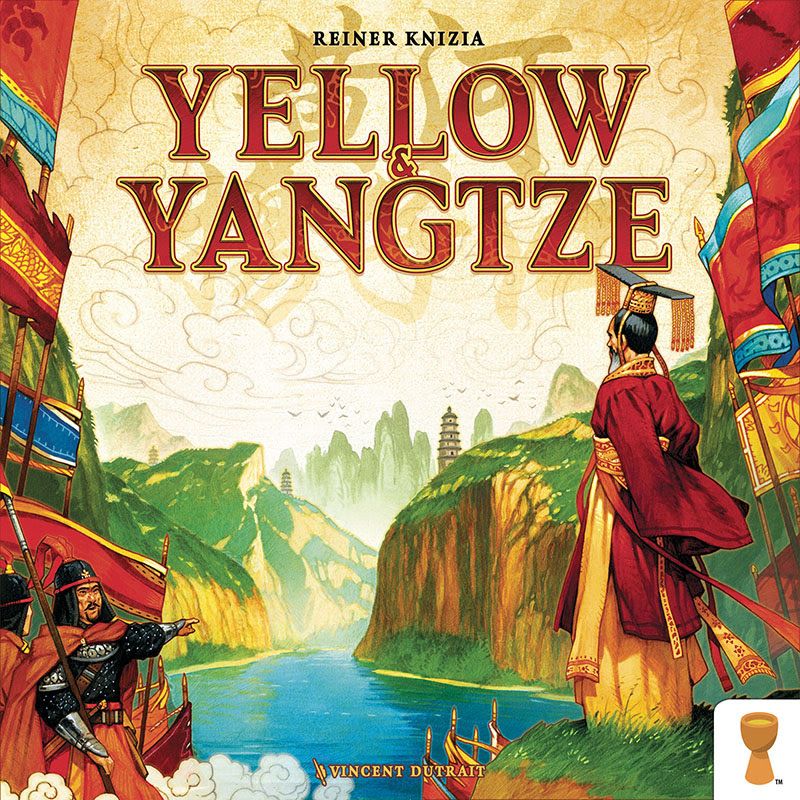
Resumo
Yellow & Yangtze is a tile-placement game for 2-4 players about rival states of ancient China. Players build civilizations, place leaders, and resolve conflicts while collecting victory points in five categories. Your final score is the number of points in your weakest category, and the highest score wins.
Preparação
Place the board in the middle of the play area. Put one black governor tile on each marked capital space. Place all pagodas and victory point tokens by the board, sorted by color, and set the red unification marker beside it. Each player picks a dynasty, places the matching screen in front of them, and sets their five leaders in front of the screen. Each player draws six tiles from the bag and keeps them behind their screen. Draw six tiles from the bag and place them face up as merchant tiles in the southern corner of the board. With two players, you may agree to remove 24 unseen tiles from the bag to make a shorter game.
Um turno
Choose a starting player at random; play proceeds clockwise. On your turn, resolve up to two actions in any order, and you may repeat the same action twice. The actions are:
- Position a leader: place one of your leaders from outside the board, move one from the board, or withdraw one. The space must be empty and adjacent to a black governor tile, not on a river, and must not unite states into a conflict.
- Place a tile: take a tile from behind your screen and place it on an empty space. Blue farmer tiles go only on river spaces; other tiles cannot go on rivers.
- Discard two blue farmer tiles to cause a peasants' riot: after discarding them, choose any one tile on the board and discard it, leaving that space empty.
- Discard two green trader tiles to establish a pagoda on an existing triangle of three like-colored tiles.
- Replace up to six tiles from behind your screen: discard any number up to six face down, then draw the same number from the bag.
Placing a green trader tile lets you take one face-up merchant tile into your supply. Placing a blue farmer tile lets you continue placing adjacent farmer tiles within the same action, as long as no conflict or new pagoda results.
Placing a tile can earn victory points: if the tile lies in a state with a leader of the same color, its owner gains a point of that color; if there is no such leader but a black governor leader is in the state, the governor's owner gains it. No point is gained when a tile causes a conflict. Victory points are kept behind your screen, and you may exchange five small tokens for one large token at any time during your turn.
At the end of your turn, collect points from any pagodas you control. Then draw tiles from the bag until you have six behind your screen; other players who have fewer than six also refill, and merchant tiles are replenished from the bag.
Fim do jogo
The game ends when a player who needs to draw a tile cannot, because the bag is empty. The game does not end when the last tile is drawn itself.
Pontuação
All players remove their screens. For each player, consider their points in the four colors black, red, blue and green; yellow points are wild and may be assigned to any other color. Each player allocates their yellow points freely to make their lowest result as high as possible. Their score is the number of points in their weakest color. The player with the highest score wins. If players tie, they compare their second-lowest results in the same way, and so on.
Variantes
A shorter two-player game is allowed by removing 24 tiles from the bag unseen before play begins.
Alterações
- Variantes, por o rascunho do manual de regras, 22 de novembro de 2026 (mostrada agora)
- Pontuação, por o rascunho do manual de regras, 22 de novembro de 2026 (mostrada agora)
- Fim do jogo, por o rascunho do manual de regras, 22 de novembro de 2026 (mostrada agora)
- Um turno, por o rascunho do manual de regras, 22 de novembro de 2026 (mostrada agora)
- Preparação, por o rascunho do manual de regras, 22 de novembro de 2026 (mostrada agora)
- Resumo, por o rascunho do manual de regras, 22 de novembro de 2026 (mostrada agora)