Regras de Yspahan
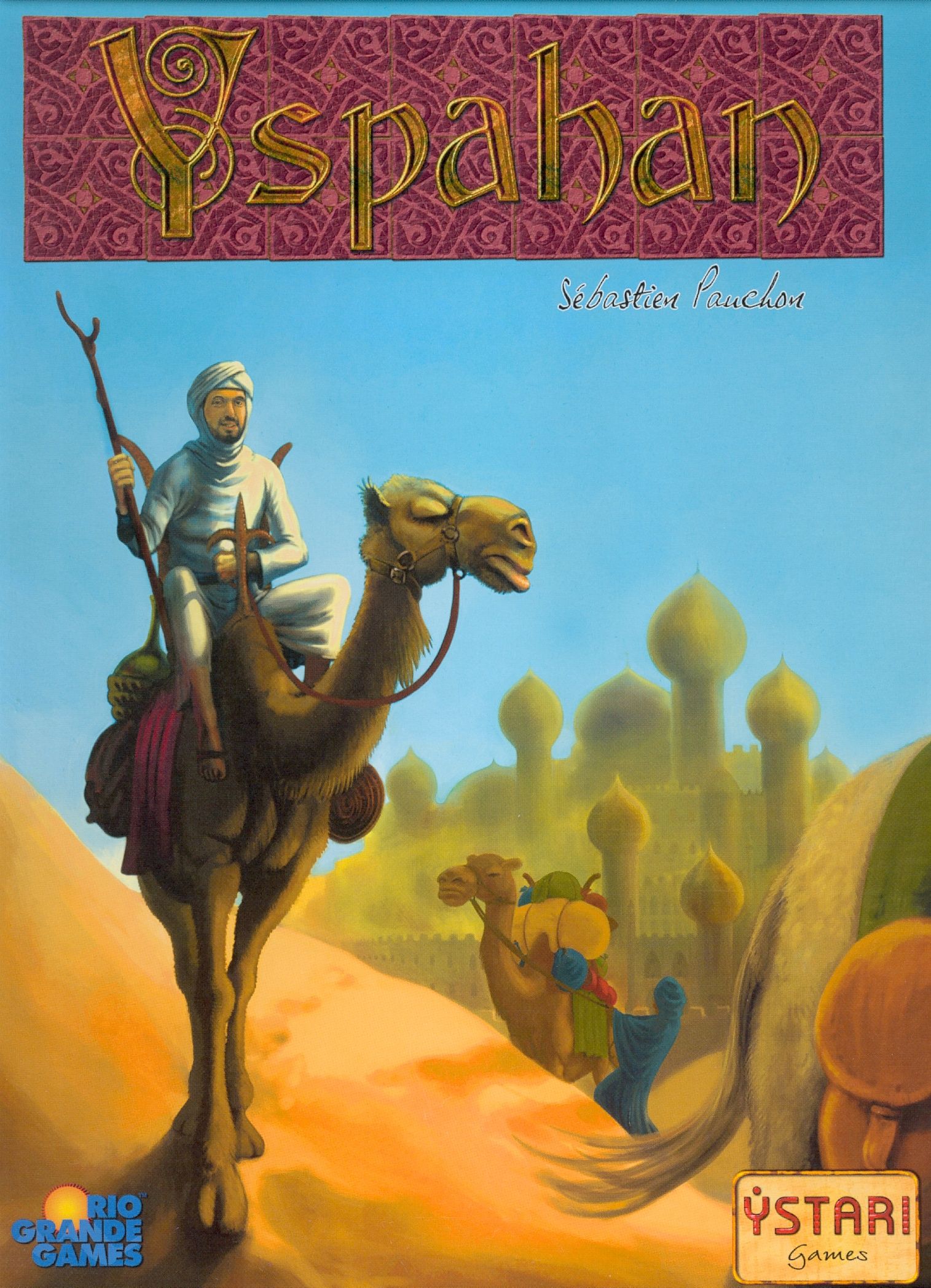
Resumo
Yspahan is a game where players are merchants trading in the city. They score by placing their cubes (goods) in the right shops, by sending goods to the Caravan, and by constructing buildings. The game lasts three weeks, and the player with the highest score at the end wins.
Preparação
Place the City board and the Tower and Caravan boards as shown in the rulebook. Put the white Supervisor pawn on the center square of the road. Set the dice near the Tower board. Put the week marker on space 1 of the week counter and the day marker on space 1 of the day counter. Keep the Gold coins and Camels together as the general stock. Shuffle the cards into a face-down deck.
Each player chooses a color, takes that color's cubes and individual board, and places one cube on square 0 of the score track. Each player starts with 2 Gold coins. The oldest player takes the black First player pawn and goes first.
Um turno
A turn is one day, with two phases.
Phase 1, Supplying: The first player takes the 9 white dice and may add 1 to 3 yellow dice, paying 1 Gold coin for each. They roll all the dice and group them by face value, ignoring color. They then fill the Tower from the lowest value upward: the lowest group goes on the Camel square, the next on the Sack square, and so on. The highest group always goes on the Gold square, so some Tower squares may stay empty. Yellow dice are removed from the Tower after the first player's action.
Phase 2, Player actions: Starting with the first player and going clockwise, each player may take up to two actions.
A) Select a group of dice (compulsory). The player removes one group from the Tower, and it is no longer available to others. The square decides the first action: the Camel square lets you take Camels, the Gold square lets you take Gold, and a neighborhood square lets you supply shops in that neighborhood or take Camels. Every square also allows moving the Supervisor and taking a card.
B) Construct a special building (optional). After the group action, the player may pay the building's cost in Gold and Camels from their personal stock and place a cube on it.
Supplying shops: Place one cube per shop, in the matching neighborhood. You cannot enter a souk occupied by another player, and you cannot start a new souk while you have an unfinished souk in that neighborhood. Excess cubes return to your stock.
Moving the Supervisor: Move him by the value of the chosen dice, adding or subtracting one square per Gold coin spent. Any cubes in shops beside his final square are sent to the Caravan, in the order chosen by the mover. A player whose cube would be sent may discard a Camel instead to keep the cube in the shop.
Caravan: Cubes fill the camels in order from the bottom left. Each cube scores points for the camel it lands on: 2 points on the bottom line, 1 on the middle line, and none on the top line. When the Caravan is full, it is counted at week's end and then emptied.
Taking a card: The player draws one card and adds it to their hand, regardless of the dice values.
If no dice group is available, the player may still draw a card from the top of the deck.
End of the day: Empty the Tower. If the seventh day is not over, advance the day marker and pass the First player pawn to the player on the current first player's left.
Fim do jogo
The game ends when the third week is over. Each week ends after the seventh day, and the week-end counting is described in the scoring section.
Pontuação
At the end of each week, players count in turn order.
Neighborhoods: For each completed souk, a player scores the value shown on its colored square. Players with the Bazaar score 2 extra points for each completed souk they own. Unfinished souks score nothing. Afterward, all neighborhood cubes return to their owners' stocks.
Caravan: A player scores the number of their cubes in the Caravan multiplied by the highest line they occupy. The Caravan is not emptied at this point, but the week marker advances.
Buildings: The first two buildings a player constructs score nothing. The third, fourth and fifth score 5 points each, and the sixth scores 10 points.
The player with the highest final score wins. If players are tied, they share the victory.
Variantes
3-player game: The first camel on each Caravan line (shown in a lighter shade) is not used, so each line has only three camels.
4-player game: On the seventh day of the third week, players do not use turn order. Instead, they play in reverse order of their scores at the start of that day, so the lowest-scoring player becomes first. Ties are broken by who was farthest clockwise from the first player on day 6, who goes first.
Alterações
- Variantes, por o rascunho do manual de regras, 23 de novembro de 2026 (mostrada agora)
- Pontuação, por o rascunho do manual de regras, 23 de novembro de 2026 (mostrada agora)
- Fim do jogo, por o rascunho do manual de regras, 23 de novembro de 2026 (mostrada agora)
- Um turno, por o rascunho do manual de regras, 23 de novembro de 2026 (mostrada agora)
- Preparação, por o rascunho do manual de regras, 23 de novembro de 2026 (mostrada agora)
- Resumo, por o rascunho do manual de regras, 23 de novembro de 2026 (mostrada agora)