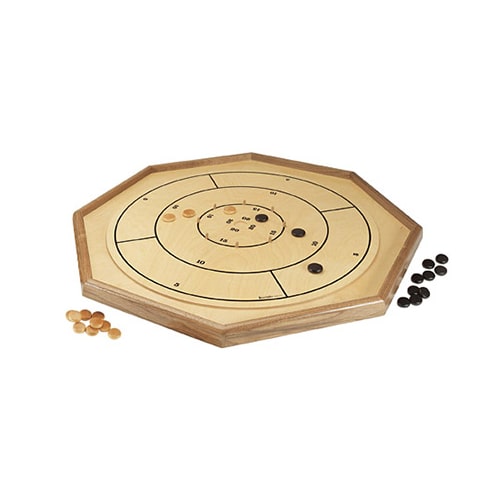
Board game mechanic
Flicking
Players flick a piece with a finger to move it, hit targets, or knock other pieces off the playing surface. The result depends on the force and angle of the shot, so physical accuracy shapes who gains ground.
Flicking is a movement and contact mechanic in which a player uses a finger to propel a piece, usually a disc or token, across the playing surface. The piece travels on momentum and stops where friction or a collision ends its motion, so the result is not fully set by the player.
On a turn, the active player presses a fingertip against the edge of one of their pieces and releases it with a quick flick toward a target. Flicks are often limited to one per turn, and some games require the piece to start inside a home area. Pieces struck by the flicked piece may be knocked off the board, moved or captured, as the rules specify. The turn then passes to the next player.
The mechanic asks players to judge angle and force, to predict how a piece might rebound or scatter others, and then to carry out that judgment with a steady hand. A well-planned shot can settle a position, but a miss can leave the player exposed, so the tension comes from the gap between intent and result. Skill improves with practice, yet the outcome always carries some physical variance, which some players enjoy and others find frustrating.
Variants mainly differ in what a flick does and where it may start. Some games allow flicks only from a home area, others let pieces strike each other in a fixed sequence, and some combine flicking with area control so that the final positions decide scoring. Pieces are usually discs, though some games use coins or cards.